 Lemon
Lemon Mandarin
 Orange
 Grapefruit
 Fruits
 Vegetables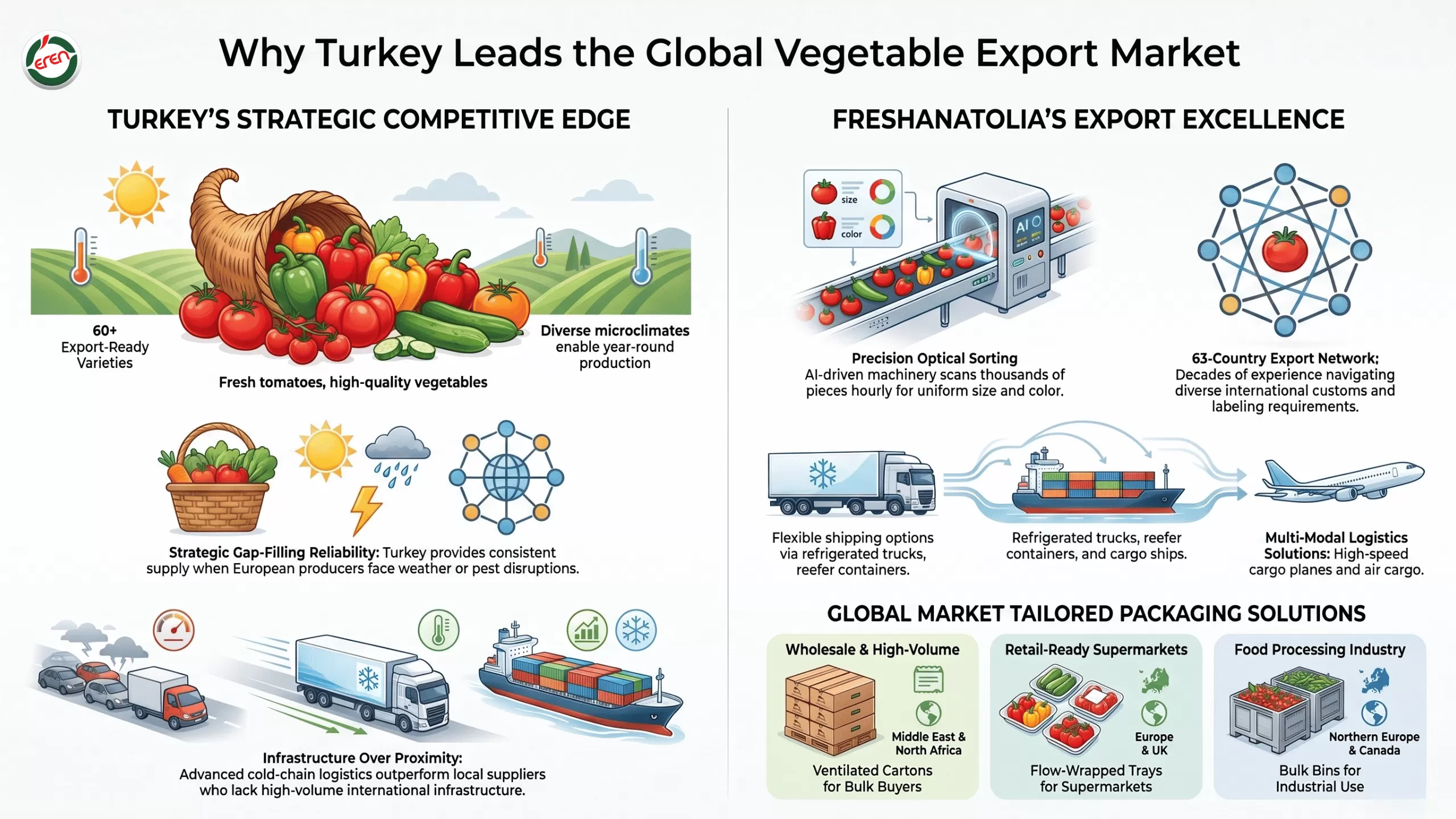
📋 Table of Contents
Turkey's Vegetable Export Business: A Complete Global Guide
If you've ever wondered how a tomato picked in Mersin ends up on a supermarket shelf in Rotterdam or Dubai within a matter of days, you're really asking about one of the most fascinating, fast-moving trade networks in the world. Turkey's geography puts it at a natural crossroads between Europe, the Middle East, Central Asia, and North Africa, and that positioning has quietly turned the country into one of the most reliable sources of fresh produce on the planet. This guide walks through what makes Turkish vegetable exports so competitive, how a company like FreshAnatolia actually gets a pepper from a field to a container ship, and what buyers around the world should know before they choose a supplier.
We'll also look honestly at the global market conditions shaping demand right now, because no export conversation in 2026 is complete without acknowledging the price swings, weather disruptions, and shifting trade routes that are reshaping who buys what, and from where. From European greenhouse dynamics to sudden import restrictions in Central Asia, the vegetable trade is anything but static, and understanding those currents is exactly what separates a smart buyer from one who gets caught off guard every season.

Everything You Need to Know About Turkey's Vegetable Export Industry, Global Trade Patterns, and FreshAnatolia's Role in It
Whether you're a wholesale buyer, a retail category manager, or simply someone curious about how fresh produce actually crosses borders, understanding the mechanics of vegetable exports can genuinely change how you approach sourcing decisions. Turkey has spent decades building an export ecosystem that few countries can match in terms of both scale and diversity, and the companies operating within that ecosystem, like FreshAnatolia, have refined every step of the process from seed to shipment.
Turkey's Position Among Global Vegetable Exporters
Turkey doesn't always get the headline treatment that the Netherlands or Spain gets in European trade press, but it consistently punches above its weight. The country sits among the largest vegetable exporters in the world, and for good reason: it grows almost everything, in almost every season, thanks to a genuinely diverse set of microclimates stretching from the Mediterranean coast to the Southeastern Anatolia region. Tomatoes, peppers, cucumbers, zucchini, and cabbage move out of Turkish ports year-round, and the country's ability to fill supply gaps left by other regions has become one of its biggest strategic advantages.
That advantage has been on full display lately. European markets have spent much of this past season dealing with erratic supply from usually dependable producers. Spanish and Moroccan tomato and pepper crops ran into repeated quality problems this year, with pest pressure, unpredictable rainfall, and fungal disease pushing prices in the Spanish region of Almería as high as three euros per kilogram at certain points, a level rarely seen even during previous shortages. Industry voices in that region have openly said the future can't look like the past, and that greenhouses need serious modernization to cope with both climate volatility and pest outbreaks like the thrips pressure that hit pepper crops particularly hard this cycle. When southern European supply falters like that, buyers start looking elsewhere, and anyone researching the biggest vegetable exporters in the world quickly finds Turkey near the top of that conversation, simply because the quality has stayed consistent for so long.
It's also worth being precise about terminology here, since buyers often search using slightly different phrasing that all points to the same underlying question. Whether someone is trying to identify the largest exporter of vegetables in the world specifically, or casting a wider net to find the largest exporter of fruits and vegetables in the world across both categories at once, Turkey shows up consistently, not necessarily as the single largest by raw tonnage in every category, but as one of the most diversified and dependable suppliers spanning both fruit and vegetable production simultaneously. That diversification matters more than people realize, because it means a single bad season for one crop doesn't sink the entire export relationship.
It's not just about filling gaps opportunistically, though. Turkey has built long-term relationships across dozens of markets specifically because it can offer year-round continuity that weather-dependent competitors sometimes can't. When a Dutch pepper packing facility in De Lier opens a new site to expand capacity ahead of full operations planned for early next year, or when Belgian tomato exporters gain ground in the UK market during a supply squeeze, that tells you the whole European vegetable trade is a fluid, competitive ecosystem, and Turkish suppliers have carved out a permanent seat at that table.
| Factor | Why It Matters to Buyers |
|---|---|
| Product variety (60+ types) | Single-supplier sourcing reduces procurement complexity |
| Year-round production | Reduces dependency on any single growing season |
| Multi-modal logistics | Flexibility across trucking, reefer, container, and air cargo |
| 63-country export network | Proven ability to meet varied customs and labeling standards |
Why "Vegetable Exporters Near Me" Isn't Always the Right Question
A lot of importers start their search with something like vegetable exporters near me or a local supplier they already know. That instinct makes sense; proximity feels safer, and there's a natural comfort in working with someone you can visit easily. But in reality, freshness, consistency, and reliability matter far more than geographic closeness once you're dealing in perishable goods that need to travel internationally anyway. A fresh vegetable exporter with strong cold-chain logistics based a thousand kilometers away can often deliver a better product, on time, more consistently than a nearby supplier without the infrastructure to handle volume or seasonal swings.
This is where established exporters differentiate themselves. Buyers researching the full range of vegetable exporting countries quickly learn that infrastructure, meaning ports, cold storage, sorting technology, and documentation systems, matters just as much as the produce itself. Turkey checks nearly every box: modern port facilities on both the Mediterranean and Aegean coasts, an increasingly sophisticated logistics sector, and decades of experience navigating the customs requirements of dozens of destination countries. Distance stops being the deciding factor once you realize how much a well-run cold chain can compress the effective "distance" between a farm in Anatolia and a distribution center in Northern Europe.
There's also a broader pattern worth noting across regional markets. In Eastern Europe and Central Asia, weekly trade reviews have repeatedly shown that price and supply shifts happen fast; cabbage and squash prices have dropped sharply in some Balkan markets in recent weeks, while cherry demand has spiked elsewhere, pulling attention (and buyer budgets) away from staple vegetables temporarily. Exporters who can read these shifts and adjust their offering quickly tend to retain buyers even when local supply elsewhere looks tempting on paper.
Inside a Real Export Operation: FreshAnatolia's Story
Understanding how a serious vegetable import export business actually operates day-to-day helps explain why some suppliers succeed globally while others struggle to scale past their local market. FreshAnatolia's story is a useful case study, because it reflects a broader pattern seen across Turkey's most established export houses, and it shows just how much groundwork goes into becoming a name that international buyers trust.
The roots of this kind of operation often go back further than people expect. Consider the trajectory of a company like Eren, established back in 1993 in Mersin as a modest export operation focused almost entirely on citrus shipments to Russia and Southern Europe. That's a humble starting point by any measure, a handful of people moving oranges and lemons into a couple of neighboring regions. But growth compounded steadily. The company expanded its head office in Mersin and began diversifying into new fruit varieties while pushing into Eastern and Western European markets that hadn't previously been on the radar.
The real transformation happened in 2006, when operations relocated to a dedicated production facility in the Tarsus region, a move that unlocked everything that followed. From there, new markets opened rapidly: Southeast Asia, Canada, Africa, and Northern Europe all became active destinations, and the product range expanded to cover essentially every fruit and vegetable variety grown in Turkey. Today, that kind of operation ships to 63 countries and manages more than 60 distinct product varieties, a scale that would have been unimaginable from the original citrus-only export desk of the early 1990s. This is precisely the kind of trajectory that defines a serious vegetable export business: it doesn't happen overnight, and it doesn't happen without consistent reinvestment in infrastructure, people, and relationships.

Quality Control and Modern Sorting Technology
Since around 2014, institutionalization has become the name of the game for competitive Turkish exporters. That means renovated digital infrastructure, software-controlled production tracking, dedicated quality control departments, and, perhaps most visibly, state-of-the-art optical sizing and sorting machinery. These machines can scan thousands of pieces of produce per hour, sorting by size, color, and surface quality far more precisely and consistently than manual sorting ever could.
This matters enormously for buyers. A shipment that's been through modern optical sorting arrives with far more uniform grading, which reduces disputes at the receiving end and speeds up customs and retail processing. It's a quiet, unglamorous part of the supply chain, but it's exactly the kind of investment that separates a professional import export vegetables operation from a smaller, less consistent supplier. Interestingly, this focus on precision isn't unique to sorting lines; growers elsewhere are experimenting with artificial intelligence systems that monitor plant stress in real time inside greenhouses, catching problems days before a human would notice them and preventing significant yield losses. Turkish exporters watching these developments closely, since the same principle, catching quality issues earlier rather than later, applies just as much on the packing line as it does in the greenhouse.
Logistics: Trucking, Reefer, Container, and Air Cargo
Getting fresh vegetables across borders without spoilage is a logistics puzzle, and the best exporters solve it with multiple transport modes rather than relying on just one. A well-run operation typically maintains its own logistics division capable of handling trucking, standard containers, refrigerated reefer containers, and air cargo, each suited to different destinations, timeframes, and product types. Leafy greens and delicate items headed to nearby markets might travel by refrigerated truck within days. Longer-haul shipments to Southeast Asia or the Americas rely on reefer containers that maintain precise temperature and humidity control throughout weeks-long voyages.
Air cargo, while more expensive, becomes essential for high-value or extremely time-sensitive shipments, and companies that treat this as its own dedicated department, with its own research and development focus, tend to serve premium retail and food-service clients far more effectively than those who treat air freight as an afterthought. Being able to offer every one of these options under one roof, rather than outsourcing logistics piecemeal, is a genuine differentiator when it comes to serious export vegetable operations trying to serve dozens of countries with dramatically different infrastructure realities. A buyer in a landlocked Central Asian market has very different logistics needs than a retailer in Rotterdam, and only an exporter with real flexibility can serve both well.

Packaging Standards That Meet International Requirements
No matter how good the produce is in the field, it means nothing if it arrives at its destination bruised, wilted, or improperly labeled. This is where vegetable export packaging becomes just as important as growing conditions. Every destination market has its own expectations; some European retailers require specific punnet sizes and recyclable materials, while Gulf markets often prefer heavier cartons that can withstand longer transit times and rougher handling during transshipment.
Professional vegetable export packing also has to account for ventilation, since vegetables like zucchini and cucumber continue respiring after harvest and can spoil quickly if airflow is restricted. Exporters that operate across dozens of countries typically maintain several packaging formats in parallel: flow-wrapped trays for supermarket chains, ventilated cartons for wholesale markets, and bulk bins for processing-industry buyers. Labeling requirements alone can be a full-time job. A shipment heading to the EU needs different traceability codes than one heading to a Gulf Cooperation Council country, and both differ again from what's required for Canada or Southeast Asia. Companies with experience across sixty-plus countries tend to build modular labeling systems that can be adapted quickly without slowing down the packing line, something smaller, less experienced exporters often struggle with.
| Packaging Type | Common Use Case | Typical Destination |
|---|---|---|
| Ventilated cartons | Wholesale, high-volume shipments | Middle East, North Africa |
| Flow-wrapped trays | Retail-ready, supermarket chains | Europe, UK |
| Bulk bins | Processing industry, food manufacturing | Northern Europe, Canada |
| Reefer-ready pallets | Long-haul, temperature-sensitive routes | Southeast Asia, Africa |
Where Turkish Vegetables Travel: Key Export Destinations
One of the more interesting things about tracking global vegetable trade is how quickly demand shifts based on weather, politics, and even currency movements. Take Kyrgyzstan, for example; tomato imports there jumped roughly eighteen percent year-on-year in the first quarter of this year, with import value climbing from around five point two million dollars to seven point two million dollars, largely because domestic production simply couldn't keep pace with local demand. Turkmenistan remains the top supplier there, but the door is wide open for other exporters willing to compete on consistency, and Chinese tomato exports to that market have reportedly grown more than fourfold, showing just how quickly a previously stable supply relationship can be reshuffled.
Elsewhere, the picture is more turbulent. Kazakhstan temporarily restricted tomato imports from countries outside the Eurasian Economic Union, a reminder that even reliable-looking markets can introduce sudden trade barriers with very little warning. Meanwhile, in the United States, tomato prices spiked nearly forty percent due to heavy reliance on Mexican tomatoes combined with a seventeen percent tariff and weather-related supply disruptions, though that particular market sits outside the priority focus for most Turkish exporters, since freight distances and existing trade agreements make Europe, the Gulf, and neighboring regions far more practical targets.
Europe itself is anything but static. French tomato production for the current season is projected at roughly four hundred ninety-five thousand tons, a slight dip from the previous year, while prices in April ran about thirty-four percent higher than the year before and forty-one percent above the five-year average, driven by strong domestic consumption and reduced import competition. Limited Spanish and Moroccan supply, hurt by poor weather, helped keep those French prices elevated, while French tomato exports actually fell by roughly eleven percent in the first quarter, opening space for alternative suppliers. Belgium, too, has been gaining ground in the UK market: their tomato season started slowly but volumes picked up by mid-April, with prices climbing toward three and a half euros per kilogram as reduced Southern European supply left room for Belgian growers to expand their footprint, and Belgian exporters have continued to lean on Germany as their primary market while pushing further into UK retail shelves.
The Netherlands remains a dominant force in glasshouse production generally, and Dutch pepper growers have been capturing market share from Spanish suppliers after a prolonged Spanish shortage. A newly opened pepper packing facility in De Lier is expected to reach full capacity by early next year, reinforcing just how competitive and fast-moving the European vegetable trade really is. Dutch cucumber prices, meanwhile, have swung dramatically within a single season, falling from a February peak to a low point just weeks later in April, which is a useful reminder that even the most established producers face real volatility. All of this reinforces why buyers researching the top vegetable exporting countries shouldn't assume any single country holds a permanent advantage; market conditions can flip within a single season, sometimes within a single month.
Turkey's advantage in this constantly shifting landscape is continuity. When a vegetable export business can offer stable year-round supply while competitors deal with pest outbreaks, tariff shocks, or temporary import bans, buyers naturally gravitate toward the more dependable option. That's precisely why so many turkish fruits and vegetables exporters have managed to build multi-decade relationships with retailers and wholesalers across such a wide range of countries, and why Turkish supply is so often the fallback that European and Gulf buyers reach for when their usual sources hit a rough patch, whether that's a Spanish disease outbreak, a Moroccan weather event, or a sudden Central Asian import restriction.
How Buyers Actually Connect With Exporters
The way international produce deals get done has changed a lot in the last decade. It's not unusual anymore for a buyer in Southeast Asia to find a supplier through a fruits and vegetables import export whatsapp group before ever picking up the phone. These informal digital networks, alongside more structured B2B platforms, have become a genuine entry point into global trade, especially for smaller importers who don't have the resources to attend every trade fair in person.
That said, informal doesn't mean unprofessional. A well-known example is the kind of trading activity seen around bombay fruits & vegetables import export circles, where buyers move quickly and expect suppliers to respond just as fast with documentation, pricing, and shipping timelines. Exporters who can operate comfortably in both the formal contract world and these faster-moving digital spaces tend to win more repeat business, simply because they meet buyers wherever they're most active.
Of course, for higher-volume, longer-term commitments, most serious import export fruit and vegetables relationships eventually move toward structured contracts, consistent quality specifications, and dedicated account management, but the initial spark of contact increasingly starts in far less formal places than it used to. A vegetable import export whatsapp group might be where a first inquiry lands, but the relationship that follows still needs the same rigor around documentation, phytosanitary certificates, and delivery schedules that any traditional trade deal requires. The channel has changed; the fundamentals of trust and reliability haven't.
Language and Regional Market Expertise
Anyone who has tried to negotiate an international shipment knows that language barriers and cultural expectations around business communication can derail a deal just as easily as a logistics problem can. This is an underrated part of what makes some exporters more successful than others. A company with sales staff speaking seven or more languages, and with over a thousand personnel during peak season, can navigate negotiations, resolve disputes, and manage documentation across dramatically different business cultures, from meticulous European retail buyers to relationship-driven Gulf trading houses.
Regional demand shifts add another layer of complexity that language and cultural fluency help manage. In Eastern Europe and Central Asia, weekly market reviews have shown cherries becoming a standout seller while tomato and cucumber prices in Ukraine have softened, and Moldova has faced extended rainfall that risks disrupting cherry harvests, which, somewhat indirectly, creates openings for other suppliers, including Turkish exporters, to fill temporary volume gaps. Armenia, for its part, has expanded government subsidies covering logistics costs and import duty compensation for fresh produce exports to the EU, UK, and Canada, specifically to offset Russian market restrictions, a move that shows just how actively governments in the region are trying to redirect trade flows right now.
Staying on top of these fast-moving regional shifts requires constant communication, which is exactly why so many companies engaged in broad export fruits and vegetables operations invest heavily in multilingual, always-available sales teams rather than relying on periodic contact. The difference between catching a market opportunity and missing it entirely often comes down to whether your sales team is monitoring the right regional signals in real time or finding out about a shift a week too late.
Building Long-Term Trust in a Volatile Market
Market volatility is the norm, not the exception, in fresh produce trade. Dutch and Belgian cucumber and pepper prices swing dramatically within a single season based on weather alone, and Austrian wholesalers serving the Asian restaurant sector have reported sharp price increases for Turkish sivri peppers specifically, driven by rising transport costs, general inflation, and geopolitical disruptions affecting supply routes through the wider region. Rather than trying to time these swings perfectly, most serious buyers prioritize working with fresh fruits and vegetables exporters who can offer predictable quality and delivery regardless of what the broader market is doing that week.
This is also where trust and reputation compound over time. Companies that have exported for thirty-plus years without major quality incidents build a kind of institutional trust that's very difficult for newer entrants to replicate quickly, no matter how competitive their pricing looks on paper. Buyers who have been burned before by suppliers who couldn't maintain consistency during a difficult season tend to place enormous value on exporters with a demonstrated track record across multiple market cycles, multiple weather events, and multiple years of shifting global trade conditions.
FAQ: Your Top Questions About Turkish Vegetable Exports
What makes Turkish vegetables competitive in international markets?
A combination of favorable growing climates, year-round production cycles across different regions of the country, modern sorting and packaging infrastructure, and decades of established trade relationships across dozens of countries.
Which countries import the most Turkish vegetables?
Turkey exports to 63 countries, with strong demand across Europe, the Middle East, North Africa, and increasingly Southeast Asia and Northern Europe, depending on seasonal supply gaps in those regions.
How do buyers typically find reliable vegetable exporters?
Many start through digital trade networks and B2B platforms, including WhatsApp trading groups, then move toward direct contracts once volume and quality expectations are established. Trade fairs and direct outreach remain important for larger, long-term partnerships.
Why do vegetable prices fluctuate so much between seasons?
Weather events, pest pressure, currency shifts, and tariff changes all influence supply and demand simultaneously, which is why prices for products like tomatoes and peppers can swing significantly even within a single month.
What packaging standards should international buyers expect?
Standards vary by destination: ventilated cartons for bulk wholesale, flow-wrapped trays for retail, and reefer-ready pallets for long-haul shipments, and experienced exporters typically maintain multiple formats to match each market's requirements.
Why FreshAnatolia Is Your Best Partner for Vegetable Exports
Whether you're building a new supply chain from scratch or looking to diversify away from a single unpredictable region, working with an established, multilingual, logistics-ready exporter makes the entire process smoother. FreshAnatolia brings decades of export experience, modern quality control, and a genuine understanding of what international buyers need, season after season, market after market. From optical sorting and flexible packaging formats to a logistics division covering trucking, reefer, container, and air cargo, every part of the operation is built around the same goal: getting fresh, high-quality Turkish vegetables to your market reliably, no matter what the broader trade landscape looks like that particular season.
If you're ready to talk sourcing, packaging, or logistics for your next shipment, reach out to the FreshAnatolia team today and let's build a supply relationship that actually holds up under pressure.