 Lemon
Lemon Mandarin
 Orange
 Grapefruit
 Fruits
 Vegetables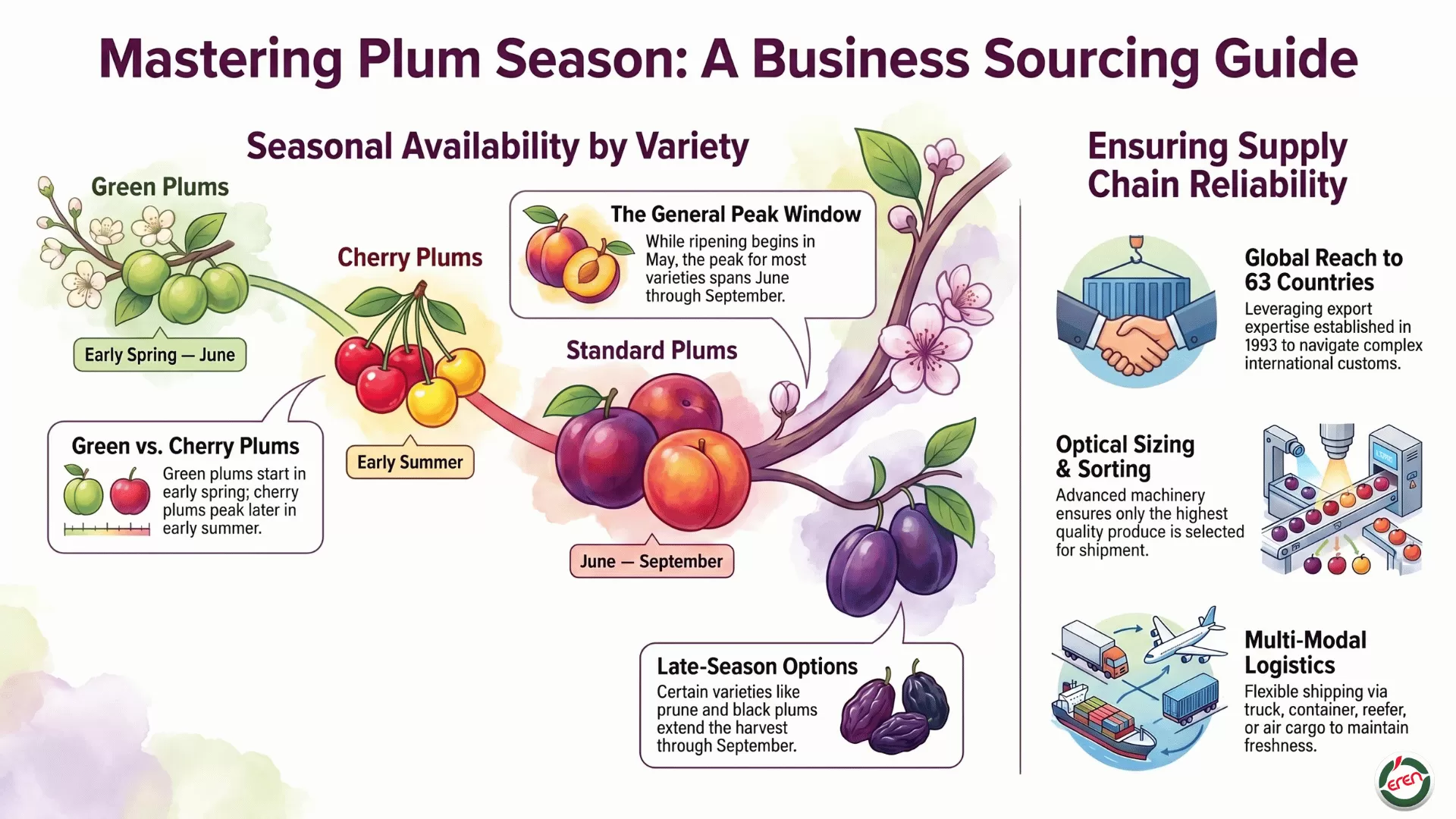
Plum Lovers' Guide: When to Harvest Plums & Enjoy Peak Flavor!
📋 Table of Contents
Are you tired of wondering when is plum season or dealing with inconsistent quality of plums for your business? You're not alone. Many businesses face the same issue, struggling to find reliable information on the season for plums and ensure they get the best plums in season. At Fresh Anatolia by Eren, we've been connecting global buyers with Turkey's finest fresh produce since 1993 — and plums are one of our most sought-after export items. If you're also sourcing other stone fruits, our guide on grape varieties and harvest windows is a great companion read.
Understanding the plum growing season is not just about calendar dates — it's about securing your supply chain, satisfying demanding clients, and staying competitive in global fresh produce markets. At Eren, we combine decades of field experience with state-of-the-art post-harvest technology to ensure you always receive plums in season, harvested at peak flavor and quality. Read on to discover everything you need to know about when is plum season and how to leverage that knowledge for your business.
How and When to Harvest Plums for Maximum Freshness
Getting the harvest timing right is the single most important factor in plum quality. Here are the three critical questions every buyer and grower must answer:
- Q: What are the key visual and tactile signs that plums are ready to harvest?
A: Ripe plums develop a deep, uniform color specific to their variety — deep purple for standard plums, golden-yellow for mirabelles, and bright red for cherry plums. The fruit should yield slightly to gentle thumb pressure near the stem end without feeling mushy. A natural waxy bloom on the skin is a reliable indicator of freshness and optimal sugar accumulation. - Q: When is plum season in Turkey, and how does it compare globally?
A: In Turkey, the season for plums typically runs from late May through September, with peak harvest concentrated in July and August. Turkish plums benefit from the Mediterranean climate of regions like Bursa, Malatya, and Mersin, producing fruit with exceptional Brix levels. Compared to European producers (June–August) and Southern Hemisphere exporters (November–February), Turkey offers a strategic mid-summer supply window that fills critical market gaps. - Q: How do different plum varieties affect harvest timing decisions?
A: Each variety has its own peak window. Green plums are harvested earliest (May–June) when still firm and tart. Black plums and Italian prunes follow in July–August, while late-season varieties like President plums extend the supply into September. Understanding this variety-by-variety calendar is essential for maintaining a continuous, uninterrupted supply to your clients.
Understanding the Optimum Plums' Harvesting Period
A precise harvest calendar is the foundation of any successful fresh plum supply strategy. Below is a month-by-month guide to the key milestones in the plum growing season:
- May – Early June: Green plums and cherry plums reach market readiness. High demand from Middle Eastern and Eastern European buyers. Harvest is hand-picked to preserve the delicate skin.
- Late June – July: Early standard varieties (Santa Rosa, Methley) begin harvest. Brix levels rise rapidly; daily monitoring is essential to catch the optimal eating-ripe window before over-maturity.
- August (Peak Season): The core plum season is in full swing. Black plums, red plums, and Italian prune varieties are harvested simultaneously. Export volumes peak; logistics planning is critical during this window.
- September: Late varieties such as President and Empress are harvested. Cooler temperatures aid post-harvest shelf life, making September plums especially popular for long-haul container shipments to Asia and North America.
- October – April (Off-Season): No domestic fresh plum production. Buyers rely on cold-storage plums or Southern Hemisphere imports. This is the ideal window to lock in forward contracts with Eren for the upcoming season for plums.

🍑 Explore Eren's Fresh Plum Supply — Request a Quote Today
Why Timing is of Essence: How Timing of Plum Harvesting Can Impact Business
Missing the harvest window — even by a few days — can have serious commercial consequences. Here are the three most common business risks associated with poor plum harvest timing:
- Quality Rejection and Chargebacks: Overripe plums deteriorate rapidly during transit, arriving at destination markets soft, fermented, or visually unmarketable. Retailers and supermarket chains apply strict quality thresholds; a single rejected container can damage a supplier relationship built over years. Harvesting 2–3 days too late is the leading cause of quality disputes in fresh plum export.
- Market Price Volatility: The plum season is short and concentrated. A late harvest means entering the market when competing suppliers have already supplied the bulk of demand, forcing price reductions. Conversely, early-season suppliers who hit the market first — with well-timed, high-Brix fruit — command premium prices and preferred supplier status with key buyers.
- Logistics Bottlenecks: During peak plum growing season, refrigerated container availability and port slots become scarce. Businesses that lack visibility into harvest timing cannot pre-book logistics resources, resulting in delays, temperature excursions, and lost sales windows. Forward planning around the season for plums is not optional — it is a competitive advantage.
Global Plums' Market and Industry Trends
The global fresh plum market is estimated to exceed USD 15 billion annually, with Turkey ranking among the top five producing countries worldwide. Turkish plum exports have grown steadily over the past decade, driven by increasing demand from Gulf Cooperation Council (GCC) countries, Russia, and Southeast Asian markets seeking premium stone fruits. The shift toward healthier snacking and clean-label produce has further elevated plum demand, as consumers recognize plums' high antioxidant content, fiber, and natural sweetness. Retailers across Europe are expanding their seasonal fruit programs, actively sourcing traceable, sustainably grown plums from trusted export partners.
Key trends shaping the plum season trade include the rising preference for premium, single-variety packs (over mixed-variety bulk), growing interest in organic and residue-free certification, and the expansion of air-freight channels for ultra-premium early-season fruit targeting high-end retail. Climate variability is also reshaping harvest calendars globally, making relationships with experienced exporters like Eren — who have multi-regional sourcing and real-time agronomic monitoring — more valuable than ever for buyers seeking supply chain resilience throughout the plum growing season.
Eren's Methods for Maintaining Quality in Plums' Harvest and Exportation
At Eren, quality is not an afterthought — it is engineered at every stage of the supply chain. Here is how we ensure every shipment of fresh plums meets international buyer standards:
- Agronomic Partnership: We work directly with a vetted network of plum growers in Turkey's prime producing regions. Our agronomists conduct weekly field visits during the plum growing season to monitor fruit development, Brix accumulation, and phytosanitary conditions — enabling precise harvest date predictions up to 10 days in advance.
- Optical Sorting and Grading: Our Tarsus facility is equipped with advanced optical sizing and color-sorting machines that process each plum individually, eliminating defects and ensuring consistent caliber, color, and skin integrity across every pallet.
- Cold Chain Integrity: From field to container, our cold chain management maintains product temperatures between 0°C and 2°C. Pre-cooling rooms, refrigerated trucks, and reefer containers are pre-booked seasonally to guarantee no temperature breaks during the critical first 48 hours post-harvest.
- Customized Packaging: We offer a full range of packaging formats — loose carton, punnet, clamshell, and retail-ready trays — each engineered to maximize shelf life and minimize bruising during long-haul transit. Private label and custom branding options are available for retail partners.
- Full Documentation and Compliance: Eren handles all phytosanitary certificates, GlobalG.A.P. compliance, customs documentation, and INCOTERMS flexibility (FOB, CFR, CIF, DDP). Our multilingual sales team supports buyers in 7 languages, ensuring seamless communication across every market.

🍑 Partner with Eren for Premium Turkish Plums — Contact Our Sales Team
Plum Season: FAQ
- When do plums come in season?
Plums are typically in season from late May through September, depending on the variety and growing region. In Turkey, the core export season peaks in July and August, with early varieties available from late May and late-season varieties extending into September. - When are cherry plums in season?
Cherry plums usually reach their peak in early summer — typically May to June in Turkey. They are among the first stone fruits to appear each year and are highly valued for their sweet-tart flavor profile and vibrant red or yellow skin color. - Are plums in season now?
Depending on the time of year and your target market, availability varies. Contact Eren's sales team directly for real-time availability updates, or refer to our seasonal calendar to confirm which plum varieties are currently at their best. - What month are plums in season?
June through September are the peak months for most commercial plum varieties. July and August represent the highest-volume export window from Turkey, with the widest variety selection and most competitive pricing. September offers excellent late-season options with naturally extended shelf life due to cooler harvest temperatures. - When is green plum season?
The season for green plums generally starts in early spring and continues through June. Green plums are harvested while still firm and unripe, prized for their tartness in Middle Eastern cuisine and pickling markets. Early booking is recommended as availability is limited and demand is high. - How do I ensure consistent plum supply year-round for my business?
The most effective strategy is to establish a forward contract with a trusted exporter like Eren, covering both in-season fresh supply and off-season cold-storage options. Diversifying across multiple plum varieties with staggered harvest windows — from cherry plums in May through President plums in September — also helps maintain inventory continuity across the full plum fruit season.
Preserving Quality After Harvest
Harvesting at the right moment is only the beginning. Post-harvest handling determines whether your plums arrive at destination in premium condition or as a liability. Here are the three pillars of effective post-harvest management for fresh plums:
- Immediate Pre-Cooling: Plums must reach target storage temperature (0–2°C) within 6–8 hours of harvest to halt ethylene production and enzymatic ripening. Forced-air cooling is significantly more effective than room cooling for large volumes. At Eren, pre-cooling begins within 4 hours of field harvest, a critical window that directly determines shelf life at destination.
- Controlled Atmosphere Storage: For medium and long-haul shipments, controlled atmosphere (CA) containers — with precisely managed O₂ and CO₂ levels — can extend fresh plum shelf life by up to 3 weeks beyond standard refrigerated transport. This technology is particularly valuable for buyers in distant markets such as Southeast Asia, Canada, and the Gulf, where transit times exceed 2 weeks.
- Handling and Stacking Protocols: Plums are among the most bruise-sensitive stone fruits. All Eren packing operations use cushioned belt conveyors, single-layer packing in foam nets where required, and strict stack-height limits to prevent compression damage. Drivers and port handlers receive product-specific handling guidelines with every Eren shipment, reducing in-transit damage rates significantly.
Eren Keeps Your Plum Value Chain in Style
From the orchards of Bursa and Malatya to retail shelves in Rotterdam, Dubai, or Singapore, Eren manages every link in your plum value chain with precision and professionalism. Here's what sets us apart as your long-term fresh produce partner:
- Farm-to-Port Traceability: Every Eren plum shipment is fully traceable from grower ID and field location to packing date and container number. Our digital documentation system allows buyers to access full traceability records within 24 hours of any quality query — a standard that meets the requirements of the world's most demanding retail chains.
- Market-Specific Customization: We understand that a retail buyer in Germany has different packaging, labeling, and compliance requirements than a wholesale importer in Dubai. Eren's team adapts every shipment — from pallet configuration to phytosanitary certification language — to the specific regulatory and commercial requirements of your market.
- Proactive Communication Throughout the Season: Our multilingual sales team provides weekly harvest updates during peak plum season, giving you advance notice of volume availability, quality grades, and pricing movements. This transparency allows you to plan your procurement strategy with confidence, not guesswork.
Founded in 1993 and now exporting to 63 countries, Eren has built its reputation on one simple promise: delivering the freshest plums in season, every season, without compromise. Whether you're a first-time buyer or a long-term partner, our team is ready to build a supply program tailored to your exact needs.