 Lemon
Lemon Mandarin
 Orange
 Grapefruit
 Fruits
 Vegetables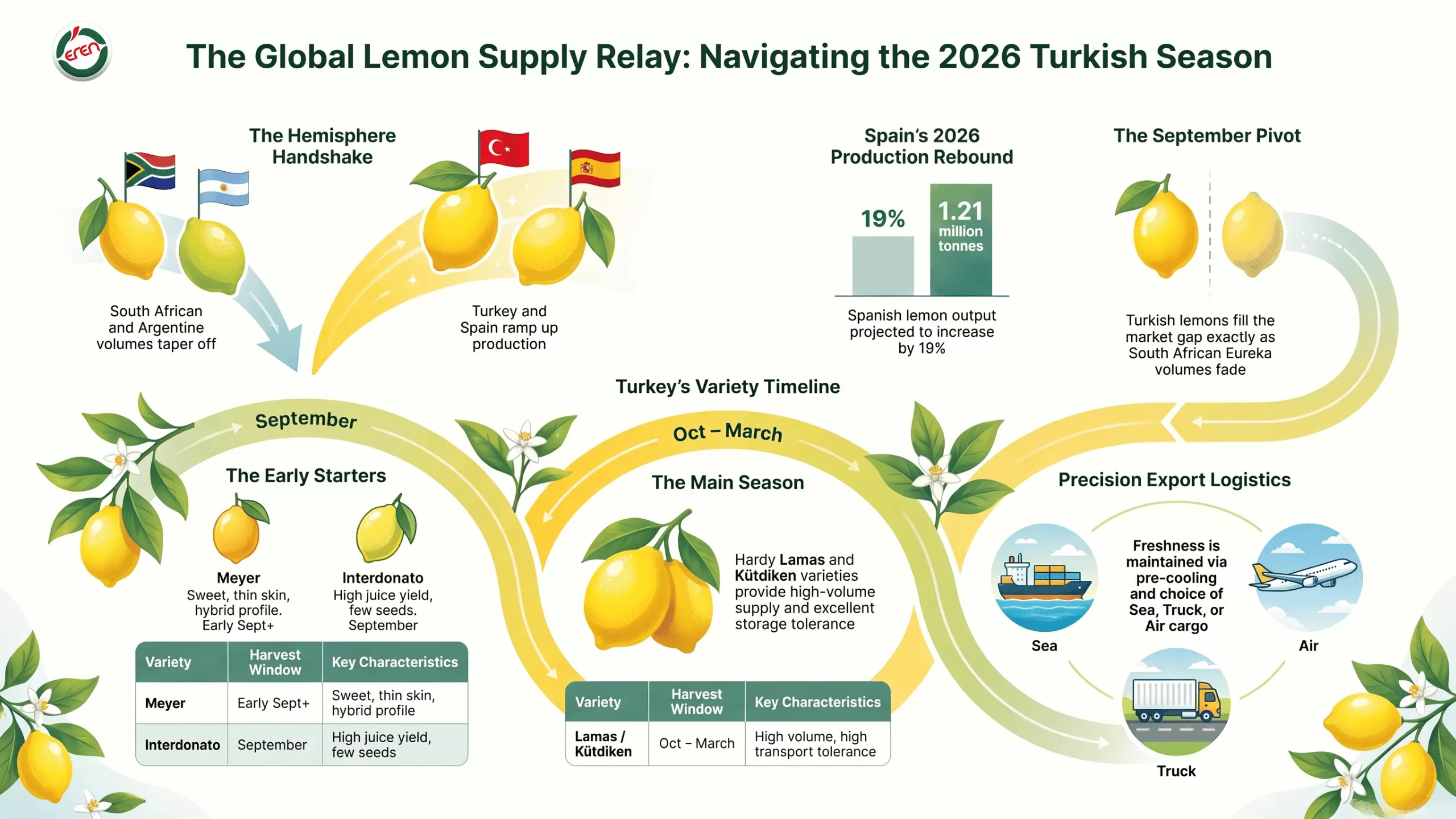
Lemon Season Guide: Lemon Growing Season, Meyer Lemon Season
If you've ever tried to pin down exactly when "lemon season" happens, you've probably run into a frustrating truth: there isn't one single answer. Lemons are grown across at least four continents, in climates that range from the Mediterranean basin to the southern tip of Africa, and each region has its own rhythm of flowering, fruiting, and harvest. For buyers, importers, and anyone sourcing citrus at scale, that complexity isn't just trivia — it's the difference between landing fruit at peak quality and scrambling for last-minute alternatives.
This guide breaks the whole picture down: what lemon season actually means, how lemon season unfolds specifically in Turkey, why the lemon growing season looks different depending on where you stand on the map, and why 2026 is shaping up to be an especially interesting year for global lemon supply. We'll also walk through the freshest development on the calendar — the meyer lemon season that has just kicked off in Turkey's Adana–Mersin region, the logistics behind getting that fruit to market, and what all of this means if you're planning your own sourcing calendar for the months ahead.

Understanding Lemon Season: A Complete Guide to Turkey's Lemon Growing Season
What Is Lemon Season, Really?
Here's the thing that trips people up: lemons are technically available somewhere in the world every single month of the year. Argentina and South Africa harvest during their spring and summer, which lines up with the Northern Hemisphere's autumn and winter. Spain and Turkey do the opposite, ramping up production as the Mediterranean cools down. So when someone asks "when is lemon season," the honest answer is "it depends which hemisphere you're buying from."
For a company sourcing out of Turkey, though, the question gets a lot more concrete. Turkish lemon season isn't a vague, year-round concept — it's a structured calendar that starts in early autumn and rolls through variety after variety until late spring. Understanding that structure is what separates a buyer who gets consistent, high-quality fruit from one who's constantly chasing gaps in supply.
It also helps to think of "lemon season" as a moving target rather than a fixed date on a calendar. Weather patterns, orchard age, irrigation practices, and even the specific microclimate of a valley can shift a harvest window by a week or two in either direction. That's why exporters rely on on-the-ground maturity testing — sugar content, juice yield, rind color — rather than simply flipping a page on the calendar and declaring the season open.
Why the Calendar Matters More Than Ever in 2026
Global citrus supply doesn't move in isolation. What happens in Spain's groves or South Africa's export terminals ripples straight into how buyers plan their Turkish sourcing. This year is a good example of that. Spain's lemon output is rebounding hard after a lean stretch, South Africa's Eureka season is winding down right as Turkey's opens up, and Turkey itself just confirmed the official start of one of its most closely watched varieties. All of that context matters if you're trying to time purchases, lock in contracts, or simply understand why prices and availability shift the way they do.
For buyers who plan procurement months in advance, these overlapping calendars aren't background noise — they're the entire basis for a sourcing strategy. A purchasing manager who understands that South African Eureka volumes taper off in September, right as Turkish Meyer and Interdonato lemons become available, can build a nearly seamless supply chain with no unnecessary gaps. Miss that window, and you're left either paying a premium for scarce late-season fruit or waiting weeks longer than necessary for the next region to come online.
Meyer Lemon Season 2026: Turkey's Big Announcement
The most significant piece of news on this year's calendar landed in early September. On September 4, 2026, it was officially confirmed that Meyer lemons grown in the Adana–Mersin belt had reached full maturity. That confirmation set off the rest of the timeline: harvesting began on September 11, and by September 21, 2026, export shipments were already underway. In practical terms, that means meyer lemon fruit season in Turkey moved from "confirmed ripe" to "on the water" in a little over two weeks — a fast turnaround that reflects how tightly Turkish growers now coordinate maturity testing, harvest crews, and export logistics.
Meyer lemons themselves are a bit of an outlier in the citrus world. They're a cross between a true lemon and a mandarin or orange, which gives them a rounder shape, a thinner skin, and a noticeably sweeter, less acidic flavor than a standard lemon. That profile makes them popular with chefs, specialty retailers, and consumers who find regular lemons too sharp. For exporters, it also means Meyer lemons often move through slightly different channels than bulk citrus — smaller, quality-focused shipments rather than high-volume commodity orders.
There's also a practical side to why this announcement gets so much attention every year. Meyer lemons are more delicate than standard varieties — their thinner skin makes them more susceptible to bruising and moisture loss during transport, which means the window between harvest and shipment needs to be tight. A confirmed maturity date followed by a fast-moving harvest and export timeline, exactly as happened this September, is the ideal scenario for keeping fruit quality high all the way to its final destination.
Why the Adana–Mersin Region Leads the Meyer Timeline
The Adana–Mersin corridor sits along Turkey's southern Mediterranean coast, an area with the warm winters, sufficient chill hours, and fertile alluvial soil that citrus trees need to thrive. It's not a coincidence that this region is consistently first to confirm ripeness each year. The combination of microclimate and decades of grower expertise means the region can reliably deliver fruit early, giving export companies a head start before the broader lemon growing season ramps up elsewhere in the country.
Soil composition plays a bigger role here than many buyers realize. The alluvial plains around Mersin and Tarsus, built up over centuries by river deposits, hold moisture well while still draining efficiently — a combination that citrus trees respond to with steady, healthy growth rather than the stress that comes from waterlogged or overly dry conditions. Add in a coastal climate that moderates temperature swings, and you get an environment where trees can be pushed toward earlier flowering without sacrificing fruit quality.
The Turkish Lemon Export Calendar: Variety by Variety
One of the most useful things to understand about Turkey's citrus industry is that "lemon season" isn't a single event — it's a relay race between varieties. Each one has its own maturity window, and together they stretch Turkey's export capability across roughly seven months.
September: The Opening Stretch
September functions as the shoulder season, the point where the calendar year's first fruit becomes available. Meyer lemons, as covered above, are the headline act here. Right alongside them, Interdonato lemons also open in September. Interdonato is one of the earliest true lemon varieties grown commercially in Turkey, valued for its thin skin, high juice content, and relatively low seed count. Its early arrival makes it a bridge variety — the fruit that fills shelves before the main-season varieties are ready.
Interdonato's popularity with exporters comes partly from its versatility. It performs well both as a fresh table lemon and as a processing lemon for juice and zest production, which gives buyers flexibility depending on what their downstream market actually needs. Because it opens the season, it also tends to command strong early-season pricing, particularly from buyers eager to secure the first fresh citrus of the autumn after a summer without significant lemon supply from Mediterranean growers.
October Through March: The Main Season
Once October arrives, the calendar shifts into its heaviest phase. Lamas and Kütdiken lemons take over and carry Turkish export volume through the winter and into early spring. These two varieties represent the backbone of Turkish lemon exports by sheer volume — they're hardier for storage and transport, which makes them well-suited to the longer shipping routes that serve markets in Northern Europe, the Gulf, and beyond. This is the period most buyers think of when they picture the core lemon fruiting season out of Turkey, running essentially from October through March.
Kütdiken in particular has a long history in Turkish citrus cultivation and remains a favorite among growers for its reliable yield and consistent fruit size. Lamas, meanwhile, has become increasingly important for export programs that need fruit capable of surviving extended sea freight without significant quality loss — a critical requirement for buyers in more distant markets who can't rely on short trucking routes.
Why Staggered Varieties Are a Strategic Advantage
This layered structure isn't accidental — it's the result of decades of variety selection and orchard planning by Turkish growers. By staggering harvest windows across Meyer, Interdonato, Lamas, and Kütdiken, exporters like EREN can offer near-continuous availability from early September through the following spring, rather than a single short burst of supply. For buyers, that translates into more predictable contract planning and fewer supply gaps.
This staggering also spreads risk. A weather event or pest pressure that affects one variety's window doesn't necessarily touch the others, since they're often grown in different micro-regions or respond differently to seasonal conditions. For an export partner managing relationships with buyers across dozens of countries, that built-in redundancy is a meaningful part of what keeps supply commitments reliable year after year.

| Variety | Typical Turkish Harvest Window | Notable Characteristics |
|---|---|---|
| Meyer Lemon | Early September onward | Sweeter, thin skin, mandarin/orange hybrid |
| Interdonato | September (early season) | Thin skin, high juice yield, few seeds |
| Lamas | October – March | High volume, strong storage/transport tolerance |
| Kütdiken | October – March | Traditional Turkish variety, consistent yield |
Lemon Growing Season in Turkey: From Blossom to Harvest
Before any lemon reaches an export container, it goes through months of biological development in the orchard. Understanding this growing cycle helps explain why maturity announcements — like the one that opened this year's Meyer season — matter so much to exporters and buyers alike.
Flowering: The First Signal of the Season Ahead
Lemon trees typically flower in spring, producing fragrant white blossoms that eventually set fruit. This lemon tree flowering season is a critical window for orchard managers, since flower and young shoot development directly determines the size and quality of the eventual harvest. Growers and agronomists across lemon-producing regions pay close attention to this stage, monitoring young growth carefully because problems introduced during flowering tend to show up as quality issues months later at harvest.
Weather during flowering can make or break a season before it's even begun. Late frosts, unexpected heat spikes, or heavy rain during bloom can reduce fruit set significantly, which is why growers in the Adana–Mersin region keep such close watch on spring conditions. A strong, even bloom is often the earliest indicator that a variety is on track for a healthy, well-timed harvest later in the year.
Fruit Development and the Long Wait to Maturity
After flowering, fruit takes several months to develop and mature — the exact timeline depends on variety, climate, and orchard management practices. This is where the difference between early varieties like Meyer and Interdonato and later ones like Lamas and Kütdiken becomes clear: earlier-flowering, faster-maturing trees deliver fruit by September, while others need the additional months of warmth to reach full ripeness by October or later.
During this development phase, orchard teams manage irrigation and nutrition carefully to support steady fruit growth. Too little water can stress the tree and produce smaller, thicker-skinned fruit with lower juice content; too much can dilute sugars and increase susceptibility to fungal issues. Getting this balance right over several months is as much a part of "lemon season" as the harvest itself, even though it happens well out of sight of the eventual buyer.
Harvest Timing: Why Precision Matters
Lemons don't ripen further once picked the way some fruits do, so harvest timing is everything. Pick too early and the fruit lacks juice content and proper acidity balance; wait too long and quality can decline or fruit can become vulnerable to weather damage. That's exactly why this year's announcement was structured the way it was — official confirmation of maturity on September 4, followed by a defined harvest start on September 11, and export shipments beginning September 21. Each step exists to make sure fruit leaves Turkish orchards at its best possible condition.
Harvest crews typically hand-pick lemons to avoid the bruising that mechanical harvesting can cause, clipping fruit carefully rather than pulling it to prevent tearing the rind at the stem end — a small detail that significantly affects shelf life during the following weeks of transport and storage.
From Orchard to Port: The Export Logistics Behind Lemon Season
Growing quality fruit is only the first half of the equation. Getting that fruit from a Mersin or Tarsus orchard into a buyer's warehouse thousands of kilometers away, while it's still fresh, is its own complex operation — and it's one that shapes how buyers should think about ordering during any part of the season.
Cold Chain Management
Citrus fruit is far more forgiving than many other fresh products, but temperature control still plays a major role in preserving quality over long transit times. Once picked, lemons typically move quickly into pre-cooling facilities that bring down field heat before the fruit is packed, which slows respiration and helps maintain firmness and juice content throughout the journey ahead. From there, refrigerated storage and transport keep conditions stable until the fruit reaches its destination market.
Packaging and Sizing Standards
Before any lemon leaves a packing facility, it passes through sizing and sorting equipment that groups fruit by diameter, weight, and visual quality. This isn't just about aesthetics — different markets often have specific size and grade preferences, and matching those preferences precisely is part of what keeps long-term buyer relationships stable. Packaging materials, labeling, and box configurations are also tailored to each market's regulatory and retail requirements, since a carton destined for a Northern European supermarket chain looks quite different from one headed to a Gulf wholesale market.
Shipping Modes: Matching the Route to the Market
Not every shipment moves the same way. Reefer containers by sea remain the most common and cost-effective method for high-volume orders heading to distant markets, offering precise temperature and humidity control over multi-week voyages. Trucking works well for closer regional markets across Europe and the Middle East, where transit times are short enough that refrigerated road transport keeps fruit in excellent condition. For time-sensitive or premium shipments — smaller Meyer lemon orders bound for specialty retailers, for instance — air cargo offers a faster alternative, trading higher cost for significantly reduced transit time.
Choosing the right shipping mode isn't just a logistics detail; it directly affects the freshness a buyer receives. A well-organized exporter matches the shipping method to both the variety's storage tolerance and the buyer's specific timeline, rather than defaulting to a single method across every order.
| Shipping Method | Best Suited For | Typical Transit Considerations |
|---|---|---|
| Reefer Sea Container | High-volume, longer-distance markets | Cost-effective, precise climate control over weeks |
| Refrigerated Trucking | Regional markets (Europe, Middle East) | Short transit time, ideal for closer destinations |
| Air Cargo | Premium or time-sensitive shipments | Fastest delivery, higher cost, ideal for delicate varieties |

Global Lemon Season Comparison: Spain's Rebound
Turkey doesn't grow lemons in a vacuum, and 2026 has brought a development that every Turkish exporter and Mediterranean buyer is watching closely: Spain's lemon crop is bouncing back in a big way.
What the Numbers Show
According to AILIMPO, the Spanish interprofessional association for citrus, projections point to Spain producing around 1.21 million tonnes of lemons in the 2026/27 season — an increase of roughly 19% compared to the previous year. Two varieties are driving much of that growth: Fino is projected to rise by about 17%, while Verna is expected to climb even further, by around 24%. Separately, Spain's Ministry of Agriculture has put out its own estimate for the country's total citrus output at approximately 5.7 million tonnes, with lemon production specifically pegged at around 991,800 tonnes, representing growth of roughly 21%.
The two estimates differ slightly in methodology and scope, but the underlying signal is consistent: Spanish lemon supply is recovering strongly after a weaker stretch, and buyers across Europe should expect a noticeably fuller Spanish crop this season.
What This Means for Turkish Exporters
A stronger Spanish harvest doesn't erase demand for Turkish lemons — but it does raise the competitive bar. When more fruit is available from a nearby Mediterranean supplier, buyers naturally weigh quality, price, and delivery reliability more carefully. For Turkish exporters, this is exactly the moment to lean into the advantages that come with an early, well-organized season: fruit that reaches European buyers with freshness intact, competitive pricing at the start of the window, and logistics that don't leave importers waiting.
It's also worth noting that Spain and Turkey aren't purely competitors in every market. Buyers in some regions diversify sourcing across both countries deliberately, using the overlap in their seasons as a way to hedge against weather disruptions, currency shifts, or capacity constraints in either supply chain. A stronger Spanish crop this year may simply mean more buyers have room to work with two reliable Mediterranean sources rather than depending on just one.
| Region | 2026/27 Outlook | Key Detail |
|---|---|---|
| Spain (AILIMPO estimate) | ~1,214,600 tonnes (+19%) | Fino +17%, Verna +24% |
| Spain (Ministry estimate) | ~991,800 tonnes lemon (+21%) | Total citrus ~5.7 million tonnes |
| Turkey | Meyer season opened Sept 2026 | Export began Sept 21, 2026 |
South Africa's Eureka Lemon Season and the Handover to Turkey
Timing is one of the biggest strategic advantages in the global citrus trade, and nowhere is that clearer than in the handoff between South Africa and Turkey each year.
How South Africa's Season Is Structured
South Africa's lemon exports are dominated by the eureka lemon season, which generally runs from March through September, with the bulk of shipping volume concentrated between April and August. By the time September arrives, South Africa's export program is entering its closing, shoulder phase — winding down rather than ramping up.
A Calendar That Works in Turkey's Favor
This is where the global picture gets genuinely interesting for Turkish exporters. Turkey's own lemon season — starting with Meyer and Interdonato in September — opens right as South Africa's eureka lemon fruiting season is closing out. That's not a coincidence buyers can afford to ignore. As South African volume tapers off, European and international buyers naturally look toward the next reliable source, and Turkey's September opening puts it in exactly the right position to fill that gap without a supply interruption.
Argentina's Role in the Southern Hemisphere Picture
Argentina follows a similar seasonal logic to South Africa, with production concentrated in the Southern Hemisphere's spring and summer months. Together, Argentina and South Africa cover the period when Turkey and Spain are in their off-season, which is why global lemon buyers describe the crop as available "year-round" even though no single region grows continuously. Turkey and Spain carry the autumn-through-spring load, while Argentina and South Africa handle the opposite half of the calendar.
Understanding this four-region rotation — Turkey, Spain, South Africa, and Argentina — is genuinely useful for any buyer building a twelve-month citrus procurement plan. Rather than treating lemon sourcing as a single annual event, the smartest buyers treat it as a continuous relay, shifting suppliers as each region's window opens and closes in sequence.
Beyond the Calendar: Quality Control During Lemon Season
Knowing when lemon season starts is only half the story. What happens in the orchard during the growing season is just as important to the fruit that eventually reaches export markets.
Orchard Monitoring and Pest Management
As harvest approaches each year, growers across major lemon-producing regions intensify their monitoring for pests that can affect fruit quality — including pests like red spider mite and California red scale, both of which are closely tracked in the weeks leading up to picking. This kind of vigilance isn't limited to any one country; it's standard practice across serious citrus operations, because untreated pest pressure can quickly turn into rejected shipments or reduced shelf life.
Watching the Vulnerable Stages: Flowering and Young Fruit
Pest and disease monitoring tends to intensify around specific developmental stages — particularly during flowering, when new shoots and blossoms are especially vulnerable, and again when fruit is small and still developing. Growers pay close attention to young shoot growth, flower clusters, and small fruit specifically because problems at these stages compound as the season progresses. Getting this phase right is a major factor in whether a harvest ultimately meets export-grade standards.
Residue Management and International Compliance
Export markets each maintain their own maximum residue limits for agricultural products, and compliance isn't optional — it's a hard requirement for market access. Growers track every treatment applied to an orchard throughout the season, timing applications carefully so that residue levels fall well within the strictest limits of any market the fruit might eventually reach. This kind of documentation and traceability has become a baseline expectation for serious buyers, particularly those supplying retail chains with their own private-label quality standards.
From Orchard to Container: Export Readiness
Quality control doesn't stop at the tree. Sorting, sizing, residue management, and packaging standards all play a role in whether fruit is genuinely export-ready. For a company managing dozens of product varieties across multiple international markets, this stage is where consistency is built — the same rigorous process applied to every batch, regardless of which variety or which week of the season it's harvested in.
Why Timing Matters: Sweet Lemon Season and Buyer Advantage
Not every lemon on the market has the same flavor profile, and this is where varieties like Meyer genuinely stand apart. Meyer lemons are often grouped into what's informally called the sweet lemon season — the window when milder, less acidic citrus becomes available alongside standard, more tart lemon varieties. For buyers stocking specialty produce sections, restaurants building seasonal menus, or retailers looking to diversify their citrus offering, this distinction matters. A sweeter lemon opens up different culinary applications than a standard, high-acid variety, and knowing exactly when that fruit becomes available lets buyers plan promotions and menu changes around it rather than scrambling once it appears.
Culinary Demand and Market Positioning
Chefs and food service buyers increasingly seek out Meyer lemons specifically for their floral aroma and reduced tartness, using them in everything from desserts and cocktails to delicate sauces where a standard lemon's sharpness would overpower other flavors. That growing culinary interest has translated into steady demand growth for Meyer lemons in specialty grocery and food service channels over recent years, making early access to a fresh crop a genuine competitive advantage for buyers serving that segment.
The Early-Season Advantage
Buyers who move early in the season — right as Meyer and Interdonato varieties open in September — often get first access to the freshest fruit of the year, along with more flexibility on volume and delivery scheduling before the main Lamas and Kütdiken season creates heavier order books. Given the competitive backdrop this year, with Spain's crop rebounding and South Africa's season winding down, early engagement with Turkish suppliers is arguably more valuable in 2026 than in a typical year.
Frequently Asked Questions About Lemon Season
When does lemon season start in Turkey?
Turkey's lemon season generally opens in early September with Meyer and Interdonato varieties, then moves into its main season from October through March with Lamas and Kütdiken varieties.
Is Meyer lemon season the same as regular lemon season?
Not exactly. Meyer lemons are a distinct hybrid variety with a sweeter, milder flavor than standard lemons, and they typically open the export calendar slightly ahead of or alongside other early varieties like Interdonato.
Why is lemon available all year round in stores?
Because lemon-growing regions are spread across both hemispheres. While Turkey and Spain supply the autumn-through-spring window, Argentina and South Africa cover the opposite half of the year, which keeps global markets continuously stocked.
How does Spain's 2026 lemon crop affect Turkish exports?
A larger Spanish harvest means more competition within the European market, but it doesn't reduce demand for high-quality, reliably timed Turkish fruit — it simply raises the importance of freshness, pricing, and dependable logistics.
What makes Lamas and Kütdiken lemons important to Turkish exports?
These two varieties carry the bulk of Turkey's export volume through the main October–March season, valued for their storage tolerance and consistency across long shipping routes.
How is fruit kept fresh during long export shipments?
Pre-cooling immediately after harvest, followed by consistent refrigerated storage and transport, is the main method used to preserve quality. The shipping method — reefer container, refrigerated truck, or air cargo — is chosen based on the distance involved and how delicate the specific variety is.
Do all lemon varieties ship the same way?
No. Hardier varieties like Lamas and Kütdiken tolerate long sea voyages well, while more delicate varieties like Meyer often move through faster, smaller-volume channels to preserve their thinner skin and higher moisture content.
What should buyers watch for when planning lemon procurement?
Tracking regional harvest announcements, understanding how staggered varieties extend a single country's supply window, and factoring in competing supply from other producing regions all help buyers time their orders for the best combination of freshness, price, and availability.
Planning a Sourcing Calendar Around Lemon Season
For buyers who work months ahead of actual need — retail chains setting seasonal promotions, food service groups planning menus, or wholesalers building annual contracts — a clear picture of the global lemon calendar isn't optional, it's foundational. Getting the timing wrong doesn't just mean paying more; it can mean gaps on the shelf or scrambling to find alternative suppliers at short notice.
Building a Twelve-Month View
The most effective approach treats the year as four overlapping windows rather than a single "lemon season." Turkey's September-through-March calendar, anchored by Meyer and Interdonato early on and Lamas and Kütdiken through the winter, covers the largest single stretch. Spain's season runs on a broadly similar autumn-to-spring rhythm, offering a complementary or alternative Mediterranean source. South Africa's Eureka-led program fills the April-through-August gap, and Argentina's Southern Hemisphere timing rounds out the picture. Mapping supplier relationships against this four-region rotation, rather than relying on a single country year-round, is how experienced buyers avoid the kind of scramble that happens when one region has a weak season.
Contracting Strategies Across the Season
Different points in the calendar call for different contracting approaches. Early in a season — as with this September's Meyer opening — buyers often move on shorter-term, opportunistic orders to secure the first fresh fruit while pricing and volumes are still settling. Once a season reaches its main phase, like Turkey's October-through-March Lamas and Kütdiken window, longer-term contracts become more practical, since volume and pricing tend to stabilize. Toward the tail end of any region's season, buyers frequently watch closely for the handover to the next region, timing final orders from an outgoing supplier against the opening of the next one to avoid either overbuying near-end-of-season fruit or facing a supply gap.
The Role of Direct Grower Relationships
One factor that consistently separates reliable long-term sourcing from reactive, spot-market buying is the strength of the relationship behind it. Exporters who are also growers — with direct visibility into flowering conditions, irrigation decisions, and pest management throughout the season — can give buyers a level of forward visibility that a pure trading intermediary simply can't match. That visibility becomes especially valuable in years like this one, where regional supply dynamics are shifting and early, accurate information about harvest timing carries real commercial weight.
Sourcing Turkish Lemons with EREN
Understanding the full lemon calendar — from flowering through harvest, from Meyer's September opening to Lamas and Kütdiken's winter-long run — is exactly the kind of detail that separates a dependable citrus partner from a transactional supplier. That's the role EREN has built over more than three decades.
Established in 1993 in Mersin as a small export company, EREN began with a focus on citrus exports to Russia and South Europe. As the business grew, so did its reach — expanding into new fruit varieties and new markets across East and West Europe. In 2006, the company moved into its own production facility in the Tarsus region, a turning point that opened the door to Southeast Asia, Canada, Africa, and Northern Europe, alongside a growing product range covering nearly every fruit and vegetable variety grown in Turkey. Today, EREN exports to 63 countries and manages over 60 product varieties.
Since 2014, EREN has invested heavily in institutionalization: a renovated digital presence, software-controlled production tracking, a dedicated quality control department, state-of-the-art optical sizing and sorting equipment, and active R&D programs. The company's Sales Department speaks seven languages and, during peak season, the team grows to more than 1,000 personnel. EREN also runs its own logistics division, offering trucking, container, reefer, and air cargo solutions with flexible INCOTERMS pricing to destinations worldwide — including a dedicated air cargo team with its own R&D focus. Beyond exporting, EREN is also a grower in its own right, cultivating citrus and cherry orchards directly, which gives the company firsthand insight into exactly the flowering, fruiting, and harvest dynamics covered throughout this guide.
That combination — growing experience, export infrastructure, and decades of relationships across 63 markets — is what allows EREN to navigate a calendar as layered as Turkey's lemon season with precision rather than guesswork. As this year's Meyer lemon season gets underway and the broader lemon growing season builds toward its main October–March run, EREN is ready to supply fresh, export-grade lemons — Meyer, Interdonato, Lamas, and Kütdiken alike — to buyers around the world. If your business is planning ahead for this season's lemon sourcing, now is the time to connect with EREN's team and secure your place in this year's export calendar. We're proud to bring you the "Treasured Anatolia's" produce, harvested with care and delivered with the reliability that three decades in this industry have made possible.