 Lemon
Lemon Mandarin
 Orange
 Grapefruit
 Fruits
 Vegetables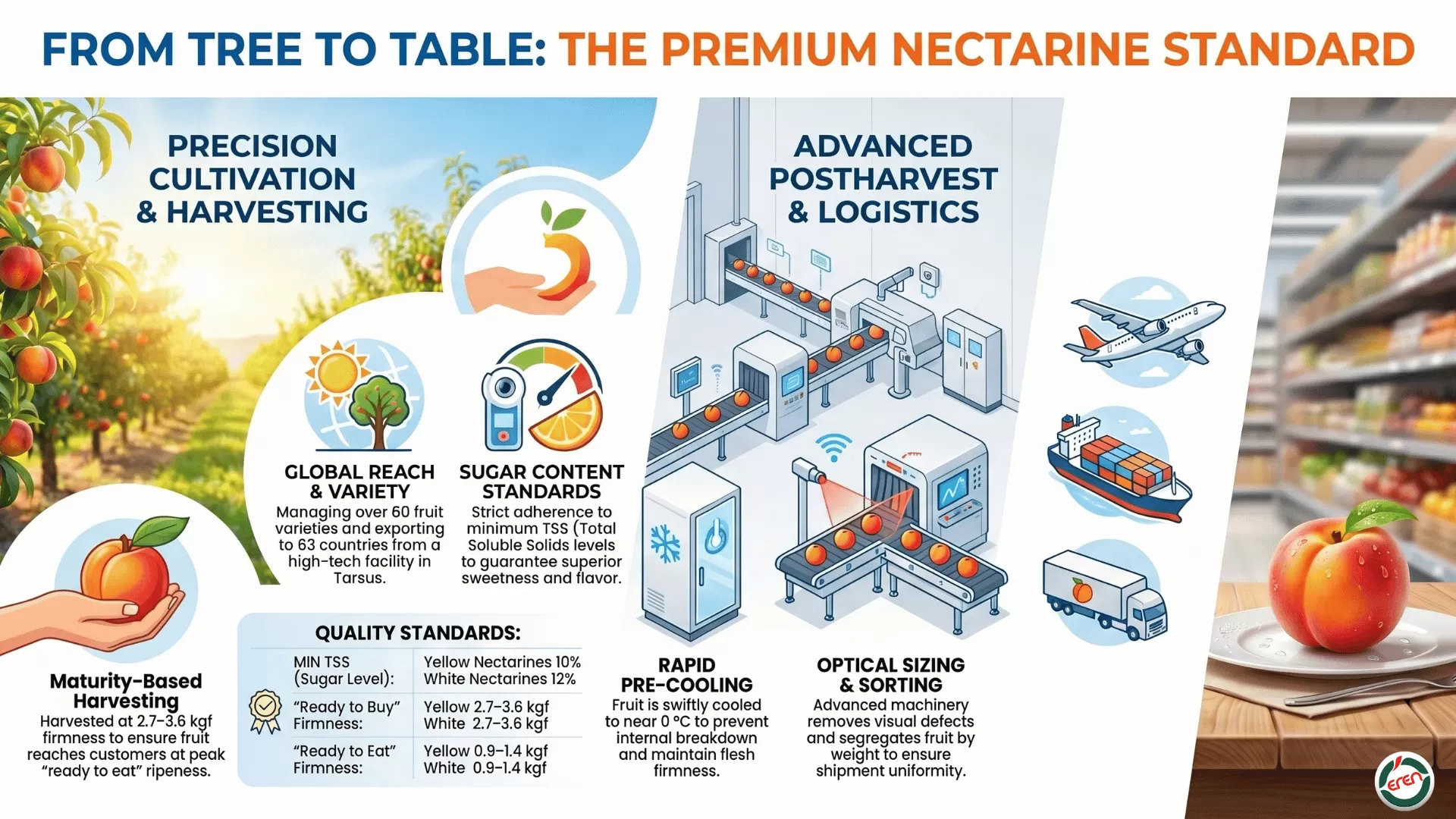
Nectarine Lovers' Guide: When to Harvest Nectarines & Enjoy Peak Flavor!
📋 Table of Contents
Feeling the pain of inconsistent nectarine quality? You're not alone. Many importers and wholesalers struggle to find a reliable nectarine producer that delivers premium quality consistently — shipment after shipment, season after season. At Fresh Anatolia by Eren, our global nectarine production capabilities are built on three decades of export expertise, ensuring every nectarine you receive meets the highest international standards. If you also source other stone fruits, our guide on peach harvest timing is a valuable companion read.
Understanding when and how nectarines are harvested is not just agronomic knowledge — it is the foundation of a resilient, profitable fresh produce supply chain. From Turkey's sun-drenched orchards to your clients' shelves, Eren manages every link in the nectarine value chain with precision. Read on to discover everything you need to know about premium nectarine production and how to leverage Eren's expertise for your business.
How and When to Harvest Nectarines for Maximum Freshness
Harvesting nectarines at the right moment is the single most critical factor in delivering premium quality to end buyers. Here are the three questions every sourcing professional must be able to answer:
- Q: What are the key indicators that nectarines are ready to harvest?
A: Ripe nectarines display full varietal color development — from deep yellow-red in standard varieties to creamy white in white nectarine types. Flesh firmness drops to the 2.7–3.6 kgf "ready to buy" range, while TSS reaches a minimum of 10% for yellow flesh varieties and 12% for white flesh varieties. A natural, sweet aroma at the stem end confirms full sugar development. - Q: When is nectarine season in Turkey, and how does it compare globally?
A: Turkey's nectarine season runs from late June through September, with peak harvest in July and August. The Mediterranean climate of Turkey's Aegean and Mediterranean regions — including key production areas around Bursa and Mersin — delivers fruit with exceptional Brix levels and vibrant color. Compared to Spanish (June–August) and Chilean (December–March) supply windows, Turkish nectarines fill a critical mid-summer demand peak for Northern European and Gulf buyers. - Q: How do nectarine varieties affect harvest timing decisions?
A: Early-season varieties reach maturity from late June onward, while mid-season and late-season cultivars extend the harvest window through September. White nectarine varieties tend to have a shorter, more concentrated peak compared to yellow-flesh types. Managing a multi-variety sourcing program across the full nectarine season ensures continuous availability and competitive pricing for buyers.
Understanding the Optimum Nectarines' Harvesting Period
A clear harvest calendar is the backbone of any successful nectarine procurement strategy. Here is the month-by-month guide to Turkey's nectarine season:
- Late June – Early July: Early-season yellow nectarine varieties reach commercial maturity. Fruit firmness is optimal for long-haul export; Brix levels are rising. Pre-booked logistics are essential as early-season availability is limited and demand from European retail is high.
- July (Peak Early-Mid Season): The broadest range of nectarine varieties is available simultaneously. This is the prime window for volume sourcing — competitive pricing, maximum variety choice, and optimal quality. Export volumes peak toward end of July.
- August (Peak Mid-Late Season): White nectarine varieties reach their peak. Higher sugar content and softer texture require careful cold chain management. Premium retail markets in the UK, Germany, and Scandinavia prioritize white nectarines during this window.
- September: Late-season varieties extend supply. Cooler overnight temperatures improve natural shelf life, making September nectarines especially suited for longer-transit container shipments to Asia and the Gulf.
- October – June (Off-Season): No domestic fresh nectarine production. Southern Hemisphere imports (Chile, South Africa) fill the gap. This is the ideal window to plan forward contracts with Eren for the upcoming Turkish nectarine season.

🍑 Explore Eren's Fresh Nectarine Supply — Request a Quote Today
Why Timing is of Essence: How Timing of Nectarine Harvesting Can Impact Business
Even a 48-hour delay in harvest can transform a premium nectarine shipment into a commercial liability. Here are the three most damaging business risks of poor harvest timing:
- Quality Rejections and Financial Loss: Nectarines harvested even slightly past peak firmness arrive soft, bruised, or showing internal breakdown at destination. Supermarket and retail chain buyers apply strict arrival quality standards — a single rejected container not only results in immediate financial loss but can cost a supplier their listing entirely. Flesh firmness monitoring at harvest is non-negotiable for export-grade production.
- Market Timing and Price Erosion: The nectarine season is short and supply-concentrated. Suppliers who miss the early-season premium window — when demand outpaces supply and prices are highest — are forced to sell into a saturated mid-season market at compressed margins. Eren's agronomic monitoring enables harvest date predictions up to 10 days in advance, giving buyers the lead time needed to secure premium market positioning.
- Logistics Pressure at Peak Season: Reefer container availability tightens sharply during the July–August stone fruit peak. Businesses without advance visibility into harvest timing cannot pre-book freight resources, resulting in delays, ambient temperature exposure, and lost market windows. Partnering with an experienced global nectarine producer like Eren means logistics are planned in parallel with agronomic timelines — not as an afterthought.
Global Nectarines' Market and Industry Trends
The global fresh nectarine market continues to grow, driven by expanding consumer preference for stone fruits as healthy, antioxidant-rich snacking options. Turkey is among the top nectarine-producing countries worldwide, with its Mediterranean climate delivering fruit quality that consistently ranks among the best on international markets. Turkish nectarine exports have seen sustained growth in GCC countries, Southeast Asia, and Northern Europe, where premium stone fruit programs are expanding in major retail chains. The shift toward residue-free and organically certified fresh produce is accelerating, with buyers in the EU and UK increasingly requiring GlobalG.A.P. and organic certification as baseline sourcing criteria.
Key market trends shaping nectarine trade include the rising commercial value of white nectarine varieties among premium retail and foodservice buyers, the growing demand for retail-ready punnet and clamshell packaging over bulk loose cartons, and the increasing use of air freight for ultra-premium early-season nectarines targeting high-end retail. Climate variability is also compressing traditional harvest windows in Mediterranean Europe, creating additional supply gaps that well-positioned Turkish exporters like Eren are increasingly filling for buyers across fresh fruit import markets worldwide.
Eren's Methods for Maintaining Quality in Nectarines' Harvest and Exportation
At Eren, premium nectarine production is the result of a precisely engineered process — not chance. Here is how we ensure every shipment meets international buyer standards:
- Grower Network and Agronomic Monitoring: We work with a vetted network of nectarine growers across Turkey's prime stone fruit producing regions. Our agronomists conduct weekly field visits during the harvest window, monitoring flesh firmness (kgf), TSS, and color development to enable precise harvest date predictions up to 10 days in advance.
- Advanced Optical Sorting and Grading: Our Tarsus production facility uses state-of-the-art optical sizing and color-sorting machines that process each nectarine individually — eliminating defects and ensuring consistent caliber, color uniformity, and skin integrity across every pallet. Gentle handling protocols prevent the abrasion-related bruising that causes black spots and post-harvest quality degradation.
- Rapid Pre-Cooling and Cold Chain Management: Nectarines are pre-cooled to near 0°C within hours of harvest to halt enzymatic ripening and prevent internal breakdown. Our refrigerated facilities, pre-booked reefer containers, and temperature-monitored transport ensure no cold chain breaks from packinghouse to port — protecting the flesh texture and flavor that premium buyers demand.
- Packaging Customization: We offer the full range of packaging formats — loose carton, punnet, clamshell, and retail-ready tray — for both yellow and white nectarine varieties. Private label, custom branding, and market-specific labeling are available for retail and foodservice partners.
- Full Compliance and Documentation: Eren manages all phytosanitary certificates, GlobalG.A.P. compliance documentation, customs paperwork, and INCOTERMS flexibility (FOB, CFR, CIF, DDP). Our multilingual sales team communicates in 7 languages, ensuring seamless coordination with buyers across all 63 export markets.

🍑 Partner with Eren for Premium Turkish Nectarines — Contact Our Sales Team
Nectarine Production: FAQ
- What is the importance of postharvest operations in nectarine production?
Postharvest operations are critical to preserving nectarine quality from field to destination. Rapid pre-cooling to near 0°C halts enzymatic ripening; optical sorting eliminates defective fruit; gentle handling prevents bruising and the black spots caused by abrasion. Each step in Eren's packinghouse process is designed to protect flesh texture, firmness, TSS, and flavor — the four parameters that determine eating quality at destination. - How does Eren ensure premium nectarine production quality?
Eren combines agronomic field monitoring, state-of-the-art optical sizing and sorting machines, a dedicated quality control department, and advanced production management software to oversee every stage from orchard to export container. Flesh firmness is measured at harvest against TSS standards (minimum 10% for yellow flesh, 12% for white flesh varieties) to ensure only commercially ready fruit is packed for export. - What are the benefits of partnering with a global nectarine producer like Eren?
Partnering with Eren means access to consistent, traceable, export-grade nectarines from Turkey's top-producing regions, backed by three decades of international market experience. Eren's expertise spans customs procedures across 63 markets, diverse packaging preferences, and logistics solutions including trucking, container, reefer, and air cargo — providing end-to-end supply chain management tailored to each buyer's needs. - What makes white nectarines different, and does Eren supply them?
White nectarines have a creamy flesh, lower acidity, and higher perceived sweetness compared to standard yellow-flesh varieties, making them highly sought-after in premium retail segments across Europe and the Gulf. Eren supplies both white and yellow nectarine varieties, with harvest timing, TSS standards, and packaging customized to the specific requirements of each variety and target market. - How does Eren handle nectarine logistics for distant markets?
Eren's dedicated logistics department offers trucking, container, reefer, and air cargo solutions with INCOTERMS flexibility for every destination worldwide. For long-haul shipments to Southeast Asia, Canada, or the Gulf — where transit times exceed 2 weeks — controlled atmosphere containers are available to extend shelf life. Pre-booking of freight resources is aligned with agronomic harvest forecasts to prevent logistics bottlenecks at peak season. - When should I place orders to secure the best Turkish nectarines?
For the best variety selection, pricing, and guaranteed logistics capacity, forward contracts should be placed in April–May, ahead of the June–July early-season harvest window. Buyers who plan procurement in advance with Eren gain access to priority allocation of premium early-season fruit, pre-booked reefer capacity, and dedicated account management throughout the full nectarine season.
Preserving Quality After Harvest
Harvesting at peak maturity is only the first step. Post-harvest handling determines whether your nectarines arrive in premium condition or fall short of buyer expectations. Here are the three pillars of Eren's post-harvest quality management:
- Rapid Pre-Cooling to Near 0°C: Nectarines must be cooled to near 0°C as quickly as possible after harvest to halt ethylene production and enzymatic ripening. Unlike peaches, nectarines are less susceptible to chilling injury — making aggressive pre-cooling an effective quality preservation tool. At Eren, forced-air pre-cooling begins within hours of field harvest, directly extending the commercial shelf life at destination.
- Gentle Handling Throughout Packinghouse Operations: Abrasion during sorting, sizing, and packing is the leading cause of black spots and bruise-related quality degradation in nectarines. Eren's packinghouse uses cushioned belt conveyors, foam net individual wrapping for premium grades, and strict stack-height controls to eliminate compression damage. Cleaning machinery removes surface residues using rotating brushes and fresh cold water without damaging the natural skin bloom.
- TSS and Firmness Verification Before Shipment: Before any pallet is loaded, Eren's quality control team verifies that flesh firmness and TSS levels meet the specifications agreed with the buyer. Yellow-flesh nectarines must reach a minimum 10% TSS; white-flesh varieties require 12%. This pre-shipment verification step is the final safeguard ensuring that every container leaving Eren's facility meets premium export standards.
Eren Keeps Your Nectarine Value Chain in Style
From Turkey's sun-ripened orchards to retail shelves in Rotterdam, Dubai, or Singapore, Eren manages every link of your nectarine value chain with precision and professionalism.
- Farm-to-Port Traceability: Every Eren nectarine shipment is fully traceable from grower ID and field location through packing date and container number. Full documentation is available within 24 hours of any quality query — meeting the traceability requirements of the world's most demanding retail chains.
- Market-Specific Customization: From packaging format and labeling language to phytosanitary certification requirements and pallet configuration — Eren adapts every shipment to the specific regulatory and commercial demands of your target market, whether retail in Germany, wholesale in Dubai, or foodservice in Singapore.
- Proactive Season Communication: During the nectarine season, Eren's multilingual sales team provides weekly harvest progress updates — giving buyers advance notice of volume availability, quality grades, and variety-by-variety pricing — so you can plan procurement with confidence, not guesswork.
Founded in 1993 and now exporting to 63 countries, Eren's reputation is built on one promise: delivering premium nectarines that meet your standards, every season, without compromise.