
 Lemon
 Mandarin
 Orange
 Grapefruit
 Fruits
 Vegetables
📋 Table of Contents
Bulk Enterdonato Lemon or Farm Lamas Lemon? Season Lamas Lemon
Every autumn, the same question lands on the desks of citrus buyers from Riga to Riyadh: which Turkish lemon should we book, when should we book it, and who can actually deliver it on time? It sounds simple. In practice, it is one of the most consequential sourcing decisions a fresh produce importer makes all year, because the Turkish lemon calendar is not one season but a relay of several varieties, each with its own character, its own price behaviour and its own logistics rhythm.
This guide is written for the people who make those decisions. Whether you manage citrus procurement for a supermarket chain, run a wholesale operation in a terminal market, supply juice and food-service clients, or simply want to understand why Turkish lemons keep showing up in your price lists, you will find a practical, data-backed walkthrough here. We focus on two varieties that carry the Turkish season from early autumn through spring: Interdonato, which many buyers search for as enterdonato, and Lamas, a local classic from the Mersin coast.
We are EREN, a grower and exporter founded in 1993 in Mersin, and we have spent more than three decades packing, shipping and explaining these lemons to buyers in 63 countries. What follows is the knowledge we share with our own customers, combined with the latest market news from the 2025/26 and 2026/27 seasons.
Bulk Enterdonato Lemon, Farm Lamas Lemon and Season Lamas Lemon From Turkey
Turkey sits in a rare position in the global lemon trade. It is close enough to Europe, the Middle East and the Black Sea region to reach them by truck or short-sea container, yet its southern coast enjoys a climate warm enough to produce lemons almost continuously from late summer to spring. Very few origins can say that. Spain dominates European shelves for much of the year, South Africa and Argentina fill the northern summer, but in the transition months between those suppliers, Turkish fruit often becomes the most practical option on the table.
That is exactly where Interdonato and Lamas come in. Interdonato is the early runner, the first Northern Hemisphere lemon to reach export volume each year. Lamas follows later, carrying supply through the winter and into early spring with fruit that stores and travels well. Between them sits the Meyer selection that Turkish growers also produce in large quantities, and which we will compare along the way.
Understanding how these varieties fit together gives you leverage. You can plan programmes instead of chasing spot loads, you can negotiate with a clear picture of supply, and you can avoid the classic mistakes that happen when buyers treat "Turkish lemon" as one interchangeable commodity.
Turkish Enterdonato Lemon: The Early Window
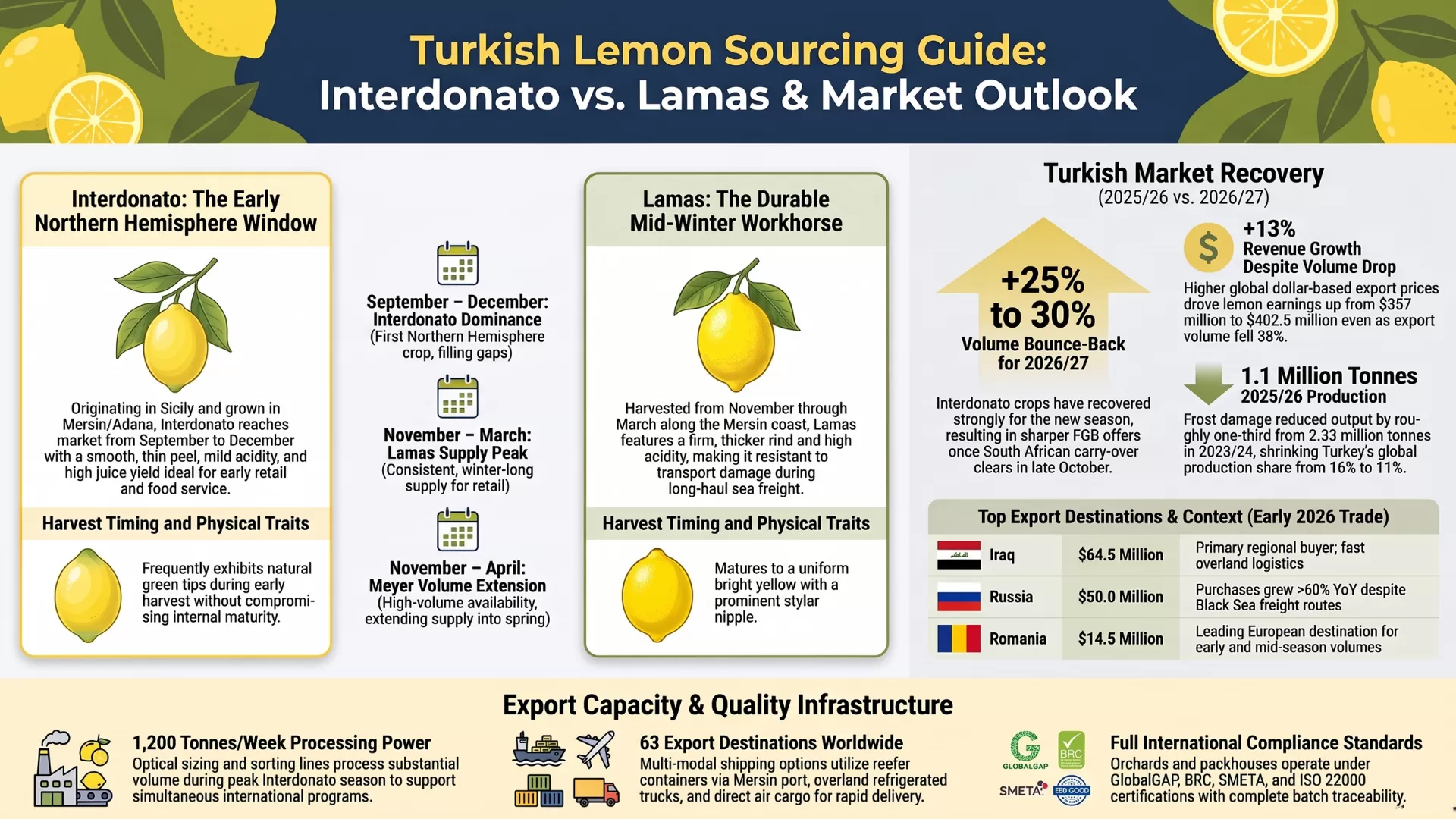
Interdonato originated in Sicily in the late nineteenth century and later found a second home along Turkey's Mediterranean coast, particularly around Mersin and Adana. In Turkey, it became the backbone of the early season. When a buyer asks about turkish enterdonato lemon, they are usually asking about fruit that reaches the market from September onwards, well before the main crops of most other Northern Hemisphere origins are ready.
That timing is the whole point. Industry voices have long described Interdonato as the variety that lets Turkey fill the gap between the end of the Southern Hemisphere campaign and the arrival of later Mediterranean crops. Although it represents only a portion of total Turkish lemon output, its strategic importance is much larger than its share, because it arrives when alternatives are thin.
What Sets Enterdonato Apart on the Shelf
Interdonato is not just early; it is distinctive. Italian growers who market it as a premium product describe a flavour that is noticeably less sharp than the classic lemon, paired with a fine, thin peel that is rich in essential oils. For retail buyers, that translates into a lemon with a smooth, glossy surface, a slightly elongated shape and an aromatic quality that consumers notice when they cut it open.
For food service and beverage buyers, the thin peel and generous juice content are practical advantages. Bartenders and kitchens get more usable juice per fruit, and the gentler acidity works well in drinks and dressings where an aggressive sourness would overwhelm other ingredients.
Reading the Green Tips Correctly
One thing that surprises first-time buyers is colour. In the first weeks of harvest, Interdonato often shows green at the ends of the fruit, even when it is fully mature inside. Sicilian producers point out that this is simply a trait of the variety rather than a sign of immaturity. Turkish fruit behaves the same way. Many markets accept this natural colour; others prefer a more uniform yellow, which can be achieved through controlled degreening in the packhouse. Clarifying colour expectations before the first shipment saves a great deal of friction later.
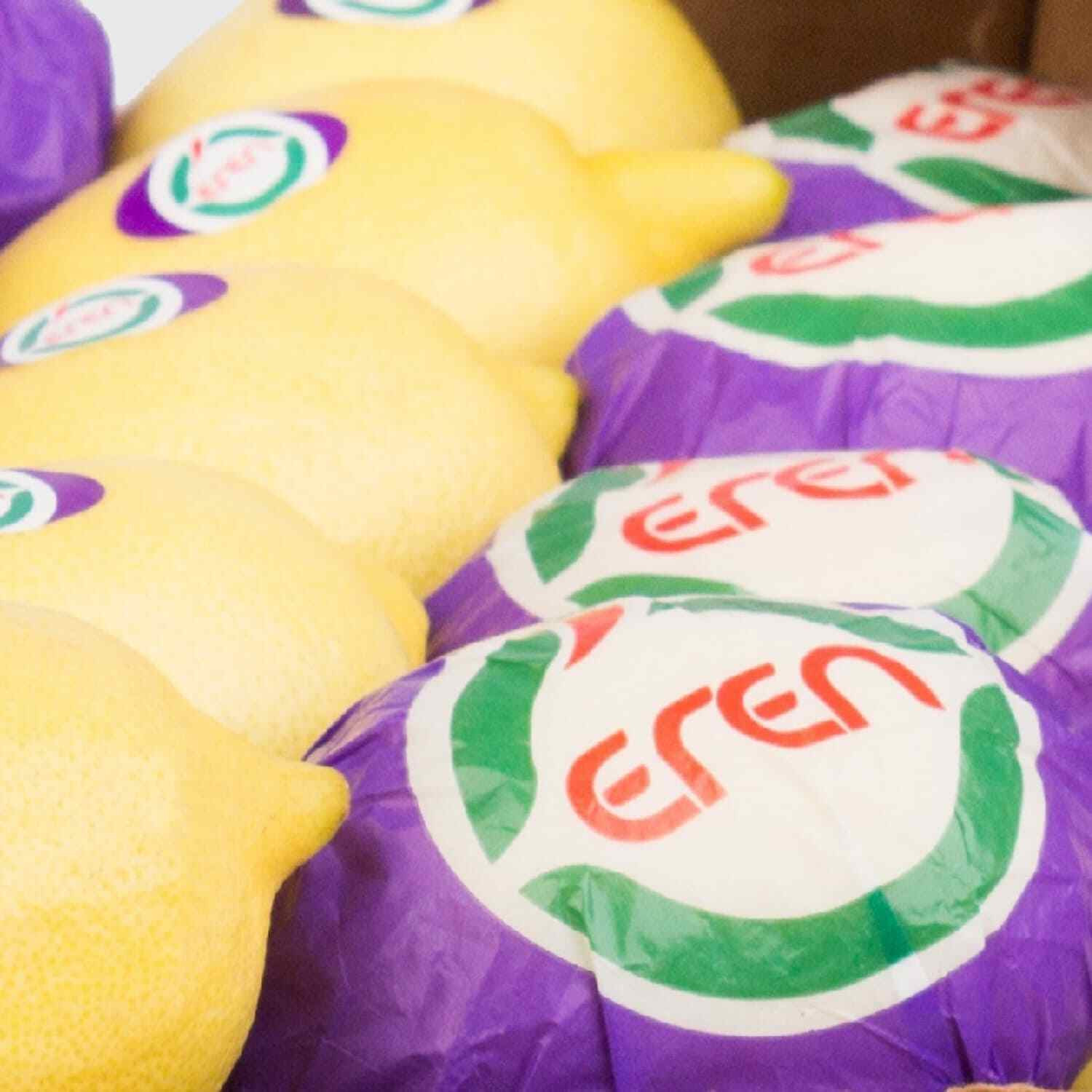
If your programme depends on having lemons on shelf in September and October, Interdonato is the variety to plan around. Booking it early, with clear agreements on size, colour and packaging, is the most reliable way to secure bulk enterdonato lemon volumes before demand peaks and the best lots are committed elsewhere.
Farm Lamas Lemon From Mersin: A Local Classic
Where Interdonato is an imported story, Lamas is a homegrown one. The variety takes its name from the Lamas area on the coast of Mersin province, where local growers selected and propagated it over generations. Today, when buyers look for in turkey lamas lemon supply, they are looking at a lemon that is deeply tied to the soil and climate of this stretch of the Mediterranean.
Origins and Growing Conditions
The Mersin coast combines mild winters, long sunny days and the moderating influence of the sea. Groves sit on the coastal plain and the lower slopes of the Taurus Mountains, where cool air from the hills meets warm air from the water. These conditions give Lamas lemons time to develop slowly, building juice and aroma before harvest. Growers who have farmed this land for decades understand its microclimates intimately, which is one reason why fruit from experienced farms tends to be more consistent than fruit from newly planted orchards.
Fruit Character and Market Fit
Lamas is typically a medium to large, oval lemon with a distinct nipple at the stylar end, a bright yellow colour once fully mature and a firm, slightly thicker rind than Interdonato. That rind is an asset in long-distance trade: it helps the fruit hold up during sea freight and storage, which makes Lamas a sensible choice for buyers shipping to distant destinations or holding stock over several weeks. The juice is high in acidity, giving the classic lemon sharpness that many consumers and processors expect.
Because it is harvested later than Interdonato and stores well, Lamas is often the lemon that carries Turkish exporters through the heart of winter. For a buyer, it is the reliable workhorse that follows the early sprinter.

Behind every carton is a grove, and the quality of that grove matters. When you source farm lamas lemon from a grower-exporter rather than a pure trader, you gain visibility into orchard management, harvest timing and traceability, all of which become more important as retailers tighten their sourcing standards.
Season Lamas Lemon and Enterdonato Calendar
The single most useful tool for a Turkish lemon buyer is a clear calendar. Turkey offers one of the longest continuous lemon supply windows of any major producer because its varieties overlap rather than stopping and starting. Interdonato opens the season, Meyer and Lamas follow, and together they stretch supply from late summer through to spring.
The table below summarises typical harvest windows for the main Turkish varieties alongside competing origins. Exact dates shift slightly each year depending on weather, so treat these as planning ranges rather than fixed deadlines.
| Variety / Origin | Typical Harvest Window | Role in the Market |
|---|---|---|
| Interdonato (Turkey) | September – December | First Northern Hemisphere lemon; bridges the Southern Hemisphere gap |
| Lamas (Turkey) | November – March | Winter workhorse with good storage and transit performance |
| Meyer (Turkey) | November – April | High-volume variety extending supply into spring |
| Primofiori / Fino (Spain) | October – June | Main European supplier through winter and spring |
| Verna (Spain) | Spring – early summer | Late-season Spanish supply, often at premium prices |
| Eureka / Lisbon (South Africa, Argentina) | Northern summer – October | Counter-seasonal supply that competes with early Turkish fruit |
How the Varieties Bridge the Year
Notice the overlaps. Interdonato starts while Southern Hemisphere stock is still in the market, which is why early-season pricing in Turkey is always influenced by how much South African and Argentine fruit remains in destination warehouses. By the time Interdonato tapers off in December, Lamas and Meyer are in full swing, and Turkish supply continues until spring, when Spanish Verna and the next Southern Hemisphere crop take over.
For buyers who want continuity, this means a single Turkish partner can often cover six to eight months of supply simply by switching varieties at the right moment. That reduces the administrative load of qualifying multiple suppliers and keeps specifications consistent for your customers.
Planning Around the Season Enterdonato Lemon Window
The season enterdonato lemon window is short and intense. Volumes ramp up quickly in September, peak in October and November, and fade by December. Because Interdonato is the earliest Northern Hemisphere fruit, demand can be strong in years when Southern Hemisphere stock clears early, and weaker in years when it lingers. Smart buyers confirm their programmes in late summer, agree on size distribution in advance and schedule weekly loads rather than relying on spot availability.
For the season lamas lemon window, the rhythm is steadier. Lamas supply builds through November, stays reliable through the coldest months and holds into March. This makes it well suited to contracted programmes with fixed weekly volumes, especially for retailers that need predictable shelf availability through the winter holidays and the post-holiday period.
Turkish Lemon Market: 2025 to 2026 in Review
To understand where prices and volumes are heading, it helps to look back at what has just happened. The 2025/26 season was one of the most unusual in recent memory for Turkish lemons, and its effects still shape buyer expectations today.
The Frost Season and Its Aftermath
In March and April 2025, a series of frosts and cold snaps hit Turkey's citrus regions at a critical stage of the growing cycle. Temperatures in the Çukurova plain, which produces around forty percent of the country's citrus, dropped far below safe levels, and a later frost affected dozens of provinces. The damage to lemon trees was severe.
According to the USDA Foreign Agricultural Service, Turkish lemon and lime production was forecast to fall by roughly a third, to around 1.1 million tonnes. Independent market economists placed the drop even higher, at more than thirty-six percent compared with the previous season, and noted that Turkey had been the world's second largest lemon producer in 2023/24 with well over two million tonnes. In just two seasons, Turkish output fell by more than half, and its share of global lemon production shrank from about sixteen percent to eleven percent.
The government responded by temporarily suspending lemon exports from early April 2025 to protect domestic supply. For importers, that meant sudden gaps in programmes and a scramble for alternative origins.
Value Over Volume
Here is the twist. Although export quantities fell sharply, export revenue actually rose. The Aegean Fresh Fruit and Vegetable Exporters Association reported that while lemon export volume dropped by around thirty-eight percent, export earnings climbed by thirteen percent, from about 357 million dollars to over 400 million dollars. The reason was a dramatic rise in dollar-based export prices, which the association's chair linked to Turkish lemons being sold with higher added value. The sector has set its sights on surpassing 500 million dollars in lemon export revenue by the end of 2026.
Who Bought Turkish Lemons
Even in a short year, demand did not disappear. In the first four months of 2026, Iraq remained the largest buyer of Turkish lemons, followed by Russia, whose purchases grew by more than sixty percent year on year, and then Romania. Over that same period, lemons generated close to 200 million dollars in export revenue and ranked as Turkey's fourth most exported fresh fruit and vegetable product, behind only mandarins, tomatoes and peppers.
| Indicator | Figure | What It Means for Buyers |
|---|---|---|
| Turkish lemon/lime output, 2025/26 | About 1.1 million tonnes, down roughly one third | A short crop that tightened supply and lifted prices |
| Turkish lemon output, 2023/24 | About 2.33 million tonnes | Shows the normal production potential when weather cooperates |
| Forecast lemon/lime exports, 2025/26 | Around 350,000 tonnes | The smallest export volume in over fifteen years |
| Lemon export revenue | Up from about $357M to $402.5M | Higher prices more than offset lower volumes |
| Jan–Apr 2026 lemon exports | About $195M | Lemons ranked fourth among Turkish fresh produce exports |
| Top buyers, Jan–Apr 2026 | Iraq ($64.5M), Russia ($50M), Romania ($14.5M) | Demand concentrated in nearby, logistics-friendly markets |
Turkey's broader citrus trade tells a similar story. In 2025, the country exported around 1.5 million tonnes of citrus, with Iraq and Russia together absorbing more than a billion dollars' worth. For buyers in Europe and Asia, this concentration matters: when nearby markets are hungry, Turkish exporters have alternatives, and long-distance buyers need to commit earlier to secure their share.
Bulk Enterdonato Lemon Outlook for the New Season
After a painful year, the 2026/27 season is shaping up very differently. If you are planning purchases right now, this is the section that matters most.
A Bigger Crop and More Competitive Offers
Speaking at the start of the campaign, Can Çakır, Export Director at EREN, described the new season as off to a solid start, with lemon harvests already underway in the Mersin and Adana regions. He noted that the Turkish citrus crop is recovering strongly after the previous shortfall, that Meyer lemons are carrying an unusually heavy crop, and that Interdonato volumes are also up. Sizes are expected to be mostly medium and well within export standards, and prices should be clearly more competitive than last season.
Market analysts echo that view. Trade reporting in early October estimated Interdonato volumes at roughly twenty-five to thirty percent above the previous season, with Meyer showing a substantially heavier crop than usual. With more fruit available, Turkish export offers are expected to be noticeably sharper than in 2025/26, particularly once Southern Hemisphere carry-over stock clears from destination markets.
The Southern Hemisphere Factor
Early-season Turkish pricing never exists in a vacuum. During the short Turkish and Spanish crops, Argentina and South Africa moved quickly to fill the gap in Europe. Argentine exporters shipped around 140,000 tonnes, roughly forty percent more than the year before, while South Africa exported about 370,000 tonnes, a rise of nearly a quarter. Early in the Argentine season, prices hovered around two dollars per kilo FOB.
Those large Southern Hemisphere volumes are now the main reason the Turkish season has started cautiously. EREN expects South African stock to clear around the end of October, after which a clear window should open for Turkish citrus. For buyers, this creates an interesting opportunity: early autumn offers may be softer than usual, while the period immediately after Southern Hemisphere fruit clears could see demand firm up quickly.

Logistics and the Russia Question
The biggest uncertainty this season is not the fruit but the route. Security developments in the Black Sea have disrupted direct shipping lines between Turkey and Russia's main ports, and shipping lines are reluctant to deploy vessels on those routes. Novorossiysk has long been a key gateway for Turkish fresh produce into Russia, and road transport cannot fully replace sea freight during peak season. As EREN's export team has put it, unless a safe corridor is established, some decline in Turkish citrus exports to Russia is hard to avoid.
Analysts suggest that, if the Russian corridor remains constrained, Turkey will need to lean more heavily on EU, Middle Eastern and Asian destinations to absorb the larger lemon crop. For buyers in those regions, that may mean better availability and more negotiating room than in recent years. The general expectation for Turkish FOB lemon prices is a mild sideways-to-downward bias in the early part of the season, as high availability meets cautious demand and freight uncertainty.
Taken together, this is a buyer-friendly start to the season, but not one to treat casually. Freight constraints can tighten supply on specific routes very quickly, and once Southern Hemisphere fruit disappears, competition for the best Turkish lots will return.
Price Enterdonato Lemon vs Price Lamas Lemon
Price is always the first question and rarely the simplest answer. Two buyers asking about the same variety in the same week can receive very different quotes, and both may be fair. Understanding what drives those differences helps you compare offers properly.
Why Enterdonato Usually Commands a Premium
The price enterdonato lemon buyers see is typically higher than for later varieties, and the reason is timing. As the earliest Northern Hemisphere lemon, Interdonato often arrives when supply is tight and alternatives are limited. In years with short Interdonato crops, Turkish exporters have reported that the variety becomes difficult to sell into Europe and the Far East when cheap Southern Hemisphere fruit is still around, yet prices stay elevated until the Interdonato window closes. This season, with larger volumes and lingering South African stock, that premium is likely to be narrower than usual.
What Shapes the Price Lamas Lemon Buyers Pay
The price lamas lemon buyers pay usually reflects mid-season market conditions. By the time Lamas reaches full volume, Spanish Primofiori is also in the market, so competition is stronger and prices tend to be more stable. Lamas is often the value choice for buyers who need reliable winter volume at predictable cost, especially for long-haul destinations where its sturdier rind reduces losses.
Size, Grade and Incoterms
Within any variety, size and grade make a big difference. Mid-range sizes that suit retail packs usually command the strongest demand, while very large or very small fruit may be priced differently or directed toward food service and processing. Class I fruit with clean skin will cost more than fruit with minor cosmetic defects, which can still be perfect for juicing or catering.
Incoterms matter just as much. An FOB Mersin price and a DDP price to a warehouse in Northern Europe are not comparable without accounting for freight, insurance, duties and handling. EREN quotes across the full range of terms, from EXW and FCA through FOB, CFR and CIF, to CPT, CIP, DAP and DDP, so buyers can compare offers on a like-for-like basis with their other suppliers.
Competitor Benchmarks Worth Watching
It is useful to keep an eye on competing origins. In Spain, the 2025/26 season closed with production of around 1.05 million tonnes and very strong prices. Origin prices for Fino lemons ranged from about 0.45 to 0.55 euros per kilo, while Verna reached roughly 0.90 to 1.00 euros per kilo. Spanish exporters also noted that their exports rose partly because Turkey cut its shipments to Europe by around half during the short year.
At the import level, European lemon prices have trended upward over the past five years. Market research for European importers shows that import prices mostly ranged between 0.70 and 1.20 euros per kilo in 2024, and frequently exceeded 1.20 euros per kilo in 2025. In France, wholesale prices for conventional lemons have been reported in a range of roughly 1.55 to 2.40 euros per kilo.
| Feature | Interdonato | Lamas | Meyer |
|---|---|---|---|
| Main harvest in Turkey | September – December | November – March | November – April |
| Peel | Thin, smooth, aromatic | Firmer, slightly thicker | Thin to medium |
| Acidity | Milder | High, classic sharpness | Moderate |
| Typical price position | Premium early-season | Stable mid-season value | Competitive, high volume |
| Best suited for | Early retail programmes, premium shelves | Long-haul shipping, winter contracts | Volume retail, food service |
| 2026/27 crop outlook | Up 25–30% on last season | Normal recovery expected | Unusually heavy crop |
Meyer deserves a mention here because it often competes with Interdonato and Lamas for the same programmes. This season, with a heavy crop on the trees, the Meyer lemon is likely to offer some of the sharpest pricing in the Turkish range, which in turn puts gentle pressure on other varieties.
Inside a Farm Enterdonato Lemon Grove
Buyers increasingly want to know where their fruit comes from, not just which country. Retailers ask for traceability down to the orchard, auditors want to see spray records, and consumers care about sustainability. That is why the conversation about any farm enterdonato lemon programme should start in the grove.
Orchard Management Through the Year
Lemon trees in the Mersin and Adana regions follow a well-defined annual cycle. Winter brings pruning and soil care, spring brings flowering and fruit set, summer is about irrigation and canopy management, and autumn is harvest time. Each stage has consequences for the final fruit. Careful pruning opens the canopy to light and air, which reduces disease pressure and improves colour. Precise irrigation keeps fruit size consistent. Integrated pest management helps keep residues low and protects beneficial insects.
The frosts of 2025 also reminded growers how important protective measures are. Wind machines, careful site selection and monitoring systems help reduce frost risk, though no technique can fully eliminate it. Growers who invest in these measures tend to recover faster after difficult years, which is one reason why experienced grower-exporters were able to restore volumes relatively quickly this season.
Harvest Timing and Handling
Picking at the right moment is critical, particularly for Interdonato, whose external colour does not always reflect internal maturity. Harvest teams check juice content and sugar-to-acid balance rather than relying on appearance alone. Fruit is clipped rather than pulled, to avoid damaging the peel, and placed into clean harvest crates that move quickly to the packhouse. The faster fruit is cooled and processed after picking, the longer it holds its quality during transit.
From Grove to Packhouse
EREN grows a range of citrus in its own orchards and works with partner growers across Turkey's main citrus regions. This combination gives us direct control over part of our supply while providing the flexibility to meet large programmes. Since 2006, our fruit has been processed in our own production facility in Tarsus, where state-of-the-art optical sizing and sorting lines evaluate each lemon for size, colour and external defects.
For sale enterdonato lemon offers to be meaningful, they need to be backed by this kind of physical capacity. During the Interdonato season, EREN's lemon programme can handle around 1,200 tonnes per week, which allows us to support multiple simultaneous customer programmes without compromising on selection.
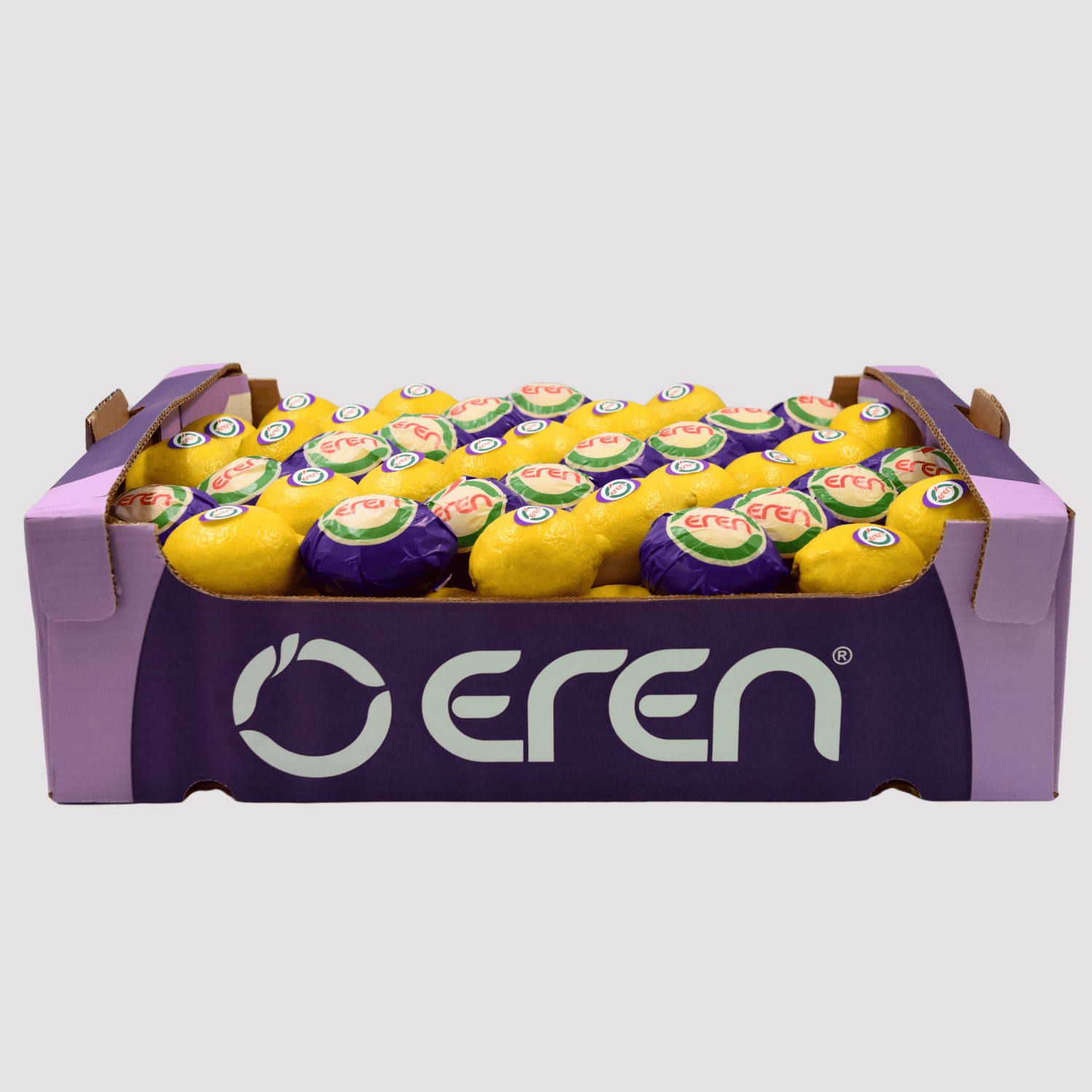
Bulk Packaging, Grading and Private Labels
Once the fruit is in the packhouse, the conversation shifts from agronomy to presentation. Every market has its own preferences, and getting packaging right is one of the easiest ways to avoid disputes on arrival.
Common Pack Formats
Turkish lemons are exported in a wide variety of formats, and the right one depends on your channel. Popular options include:
- Loose-packed cartons of around 15 to 18 kilos, the standard choice for wholesale markets and distribution centres.
- Smaller retail cartons and display trays designed to go straight onto supermarket shelves.
- Net bags and flow-packs of 500 grams to 1 kilo, ready for consumer purchase.
- Open-top and telescopic cartons with ventilation suited to long sea freight.
- Bulk bins and large-format packs for processors, juice producers and food-service distributors.
Because EREN serves 63 markets, our team is used to adapting carton specifications, pallet configurations and labelling requirements for very different destinations, from the strict retail standards of Northern Europe to the volume-driven wholesale markets of the Middle East.
Grading and Quality Control
Grading is where consistency is won or lost. Optical sorting provides objective measurements, but trained quality controllers still make the final call on borderline fruit. EREN's quality control department checks samples at reception, during packing and before loading, recording size distribution, colour, defects and firmness. These records travel with each shipment, so buyers can see exactly what was loaded.
Post-harvest treatments, waxing and degreening are applied according to each market's regulations and preferences. Organic and residue-reduced programmes are increasingly common, and buyers should share their maximum residue requirements early so that orchard and packhouse practices can be aligned.
Private Label and Branding
Many retailers prefer lemons packed under their own brand. Private labelling is straightforward once artwork, barcodes and legal declarations are agreed. EREN regularly packs under customer brands and can also supply fruit under its own brand for buyers who prefer an established Turkish label. Our sales department works in seven languages, which helps keep specifications and label texts accurate across markets.
Logistics From Mersin to 63 Countries
A great lemon is worth nothing if it arrives late or overripe. Logistics is where many Turkish citrus programmes succeed or fail, and this season, with Black Sea routes under pressure, it deserves extra attention.
Reefer Containers and Trucks
Mersin is home to one of the largest ports on Turkey's Mediterranean coast, with regular reefer services to Europe, the Middle East, North Africa and Asia. Refrigerated containers carry the bulk of long-distance shipments, holding lemons at carefully controlled temperatures and humidity throughout the voyage. For nearby markets in the Balkans, Central Europe and the Middle East, refrigerated trucks offer flexible, door-to-door delivery with shorter transit times.
EREN operates its own logistics department, which allows us to book trucking, container and reefer capacity directly, combine loads when needed and respond quickly when routes change. This season, that flexibility is particularly valuable for buyers who previously relied on Black Sea routings and now need alternatives.
Air Cargo for Premium Programmes
For premium retail and urgent orders, air freight can deliver Turkish lemons to distant destinations within days. EREN's air cargo division runs as a separate department with its own planning and research, focusing on finding the best routing and packaging for fruit that travels by air. While air freight is not economical for everyday volumes, it can be a powerful tool for launch programmes, promotional windows or high-value markets.

Choosing the Right Route This Season
With direct sea links to Russia's main Black Sea ports disrupted, buyers in that region should discuss contingency plans early, including overland options and alternative ports. For buyers in the EU, the Middle East and Asia, the new season may actually offer improved access, as Turkish exporters redirect volume toward these markets. In every case, agreeing on transit times, temperature settings and documentation before the first load reduces the risk of surprises.
Documentation matters as much as transport. Phytosanitary certificates, certificates of origin and market-specific paperwork must be correct and complete. With experience across 63 countries, EREN's export team handles these customs procedures every week and can advise buyers on the requirements of new markets.
Choosing a Company Lamas Lemon Partner
The Turkish lemon trade includes hundreds of exporters, from large integrated groups to small traders working with a single packhouse. Choosing the right company lamas lemon partner is ultimately about reducing risk: the risk of short shipments, of quality disputes, of documentation errors and of supply disappearing just when you need it most.
Certifications and Compliance
Start with the basics. Credible exporters should hold internationally recognised certifications such as GlobalGAP for farm practices, BRC for food safety in the packhouse, SMETA for ethical trade and ISO 22000 for food safety management. These are not just badges; they indicate that systems are in place and audited regularly. EREN holds these certifications and maintains software-controlled tracking throughout production, introduced as part of our institutionalisation process after 2014.
Questions to Ask Before You Commit
When evaluating a company enterdonato lemon supplier, it helps to ask concrete questions. Consider the following checklist:
- Do you grow your own fruit, or do you rely entirely on purchased supply?
- What weekly volume can you guarantee for each variety during peak season?
- Which certifications do you hold, and when were they last audited?
- How do you handle quality claims, and what documentation do you provide on loading?
- Which Incoterms can you offer, and do you manage your own logistics?
- Can you adapt packaging and labelling to our market's requirements?
- What contingency plans do you have if a shipping route is disrupted?
Why Experience Counts
Experience is hard to fake. A supplier that has worked through frost years, export suspensions and shipping disruptions knows how to communicate when things go wrong, and how to prioritise contracted customers when supply tightens. EREN was founded in 1993 as a small citrus exporter focused on Russia and Southern Europe. Over the years, we expanded into Eastern and Western Europe, then into Southeast Asia, Canada, Africa and Northern Europe. Today, we work with more than 60 product varieties, employ over 1,000 people at peak season and serve customers in 63 countries.
Hot Sale Lamas Lemon and Smart Timing
Every season has moments when offers become especially attractive. A hot sale lamas lemon offer might appear when volumes peak in mid-winter, while a hot sale enterdonato lemon opportunity can emerge in early autumn if Southern Hemisphere stock lingers and Turkish supply is plentiful. This season, with larger crops and cautious early demand, buyers may find more of these windows than in recent years.
Spot Buying Versus Programmes
Spot purchases can deliver great prices, but they come with risk. When demand suddenly firms up, spot availability can vanish, and buyers without contracts are the first to miss out. Programmes, by contrast, lock in weekly volumes and specifications, often with pricing mechanisms that reflect market movements. The most resilient buyers combine both: a contracted base volume for continuity, supplemented by spot purchases when the market offers value.
Reading the Market Signals
Watch a few key indicators. First, the pace at which Southern Hemisphere stock clears from European and Middle Eastern warehouses. Second, the progress of the Spanish Primofiori harvest, which competes directly with Turkish winter fruit. Third, freight developments on key routes, especially the Black Sea. Finally, weather in the Turkish growing regions, since frost risk remains a factor through late winter and early spring.
When those signals point toward softer prices, it can be a good time to extend programmes. When they point toward tightening, early commitment protects your supply. A good sale lamas lemon partner will share these signals with you openly rather than simply sending a price list.
Matching Variety to Purpose
Timing also means choosing the right variety for the right moment. Use Interdonato to secure early shelf presence and premium positioning. Move to Lamas and Meyer for steady winter volume. For long-haul destinations, favour fruit with sturdier rinds and plan transit times carefully. And for processing or food-service buyers, consider grades that offer excellent juice yield at a lower cost, even if their appearance is slightly less perfect.
Frequently Asked Questions
Is enterdonato the same as Interdonato?
Yes. Interdonato is the correct name of the variety, which originated in Sicily and is now widely grown in Turkey. Many buyers search for it as enterdonato, and both terms refer to the same early-season lemon.
When is the best time to buy Interdonato and Lamas lemons?
Interdonato is usually available from September to December, with the strongest volumes in October and November. Lamas typically runs from November to March. For continuous supply, many buyers start with Interdonato and transition to Lamas and Meyer as winter approaches.
Why are Interdonato lemons often more expensive?
Interdonato arrives when few other Northern Hemisphere lemons are available, so it often commands a premium. This season, larger volumes and lingering Southern Hemisphere stock are expected to narrow that premium compared with recent years.
How has the 2025 frost affected the new season?
The 2025 frosts sharply reduced the 2025/26 crop and led to a temporary export suspension. However, the 2026/27 season shows a strong recovery, with Interdonato volumes estimated to be well above last year and a heavy Meyer crop, which should translate into more competitive offers.
Can EREN ship lemons to Russia this season?
Direct sea routes to Russia's main Black Sea ports have been disrupted, which makes this route more complex than usual. EREN's logistics team works with buyers to evaluate alternative routings and overland options, and we recommend discussing plans early in the season.
What certifications does EREN hold?
EREN holds GlobalGAP, BRC, SMETA and ISO 22000 certifications, supported by a dedicated quality control department and software-based tracking across production.
Do you offer private labelling and custom packaging?
Yes. We regularly pack under customer brands and adapt carton sizes, pallet configurations and labels to the requirements of each market we serve.
Which Incoterms do you work with?
We offer pricing on EXW, FCA, FAS, FOB, CFR, CIF, CPT, CIP, DAP and DDP terms, so you can compare our offers directly with other suppliers in your portfolio.
Connect With EREN Today
The 2026/27 Turkish lemon season offers something buyers have not seen for a while: plentiful fruit, competitive pricing and a genuine opportunity to build reliable programmes for the months ahead. At the same time, shifting logistics and lingering Southern Hemisphere stock mean that timing and partner choice matter more than ever.
EREN has been part of this story since 1993. From our base in Mersin and our production facility in Tarsus, we grow, pack and ship citrus, fresh fruits and vegetables to 63 countries. Our own orchards, partner growers across Turkey, optical sorting technology, dedicated quality control, in-house logistics and separate air cargo division allow us to meet virtually any packaging, labelling and delivery requirement. Our sales team speaks seven languages, and our people understand the customs, preferences and expectations of very different markets.
Whether you are planning an early Interdonato programme, a steady Lamas contract through the winter, or a mixed lemon supply that carries you into spring, we would be glad to talk. Reach out to EREN today, tell us about your market, your volumes and your specifications, and let us show you what the Treasured Anatolia can bring to your shelves this season.


