 Lemon
Lemon Mandarin
 Orange
 Grapefruit
 Fruits
 Vegetables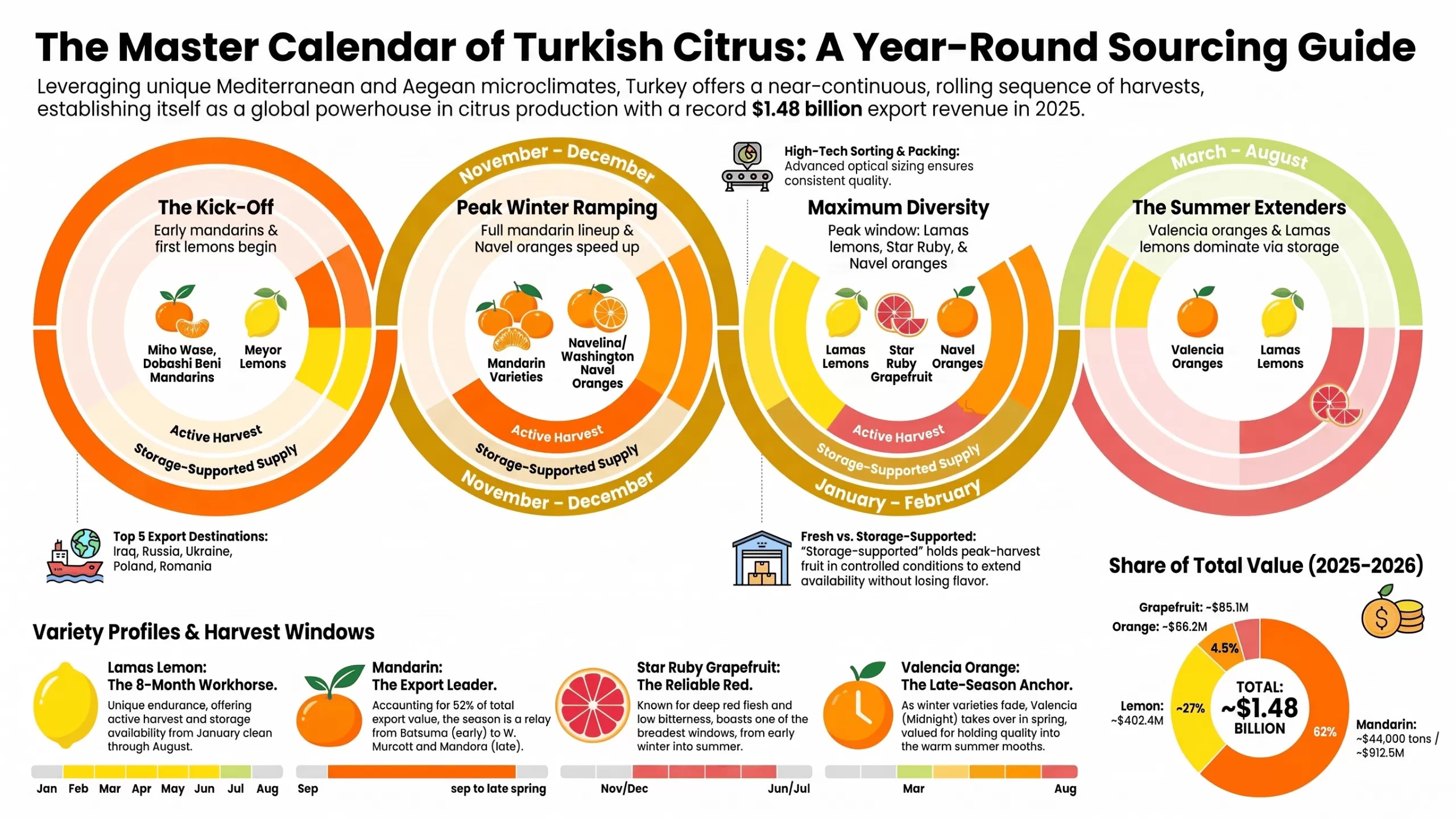
📋 Table of Contents
Turkish Citrus Fruit Season: Your Seasonal Citrus Guide
If you've ever bitten into a lemon in January and thought, "wow, this actually tastes like something," there's a decent chance it came from Turkey. Turkey's Mediterranean and Aegean coastlines have been growing citrus for centuries, and the country has quietly become one of the most reliable citrus suppliers on the planet. Whether you're a buyer trying to plan a full year of imports, a distributor looking for consistency, or just someone who's curious about where the good stuff comes from, this guide walks through everything you need to know about turkish citrus — the varieties, the timing, the numbers, and why the calendar matters so much more than people think.
We're going to get into the weeds a bit (in a good way). You'll see actual harvest windows pulled from real production data, real export figures from the past two years, and a breakdown of which fruit shows up when. By the end, you should have a genuinely useful mental map of Turkish citrus — not just "oranges grow in winter" but which orange, from which region, available in which month, and why that matters for sourcing decisions.
Most guides on this topic tend to stop at the surface level — a paragraph on lemons, a paragraph on oranges, maybe a nice photo, and that's it. This one goes further on purpose. Citrus sourcing is a scheduling problem as much as it's a quality problem, and the buyers who get the best results are almost always the ones who understand the calendar down to the variety level, not just the fruit type. So we'll walk through the individual varieties grown across Turkey's citrus regions, how their windows stack and overlap across the year, what the last two years of export data actually show, and where the fruit is actually going once it leaves the country. Consider this the reference sheet you can come back to whenever you need to double-check timing before placing an order.
What Makes Turkish Citrus So Special
Turkey sits in a genuinely lucky spot on the map. The southern coast — think Mersin, Adana, and the surrounding Çukurova plain — has that classic Mediterranean climate that citrus trees seem to love: long hot summers, mild winters, and just enough rainfall to keep things balanced without drowning the roots. It's the same basic climate band that made Spain and Southern Italy famous for citrus, except Turkey's growing regions stretch across a bigger range of microclimates, which is exactly why the variety list is so long.
This isn't a new industry either. Citrus growing in this part of Turkey goes back generations, and a lot of the expertise has been passed down family to family, farm to farm. What's changed more recently is the infrastructure around it — better sorting technology, better cold chain logistics, better packaging standards that match what European and Gulf buyers expect. So you get old-world growing knowledge paired with modern export capability, which is a pretty rare combination.
Soil quality plays a role too. The alluvial soil along Turkey's southern river deltas is naturally rich, which means less reliance on heavy fertilizer inputs to get fruit that's both large and flavorful. Combine that with plenty of sunshine hours during the growing season, and you end up with citrus that has good sugar development and solid rind quality — both things that matter a lot once you start thinking about long-distance shipping.
Geography also gives Turkey a scheduling advantage. Because the country straddles Europe and Asia and sits close to major shipping lanes through the Mediterranean, lead times to a lot of key markets are shorter than they'd be from farther-flung citrus origins. That's a quiet but real advantage when you're trying to get fruit to a shelf while it's still at peak condition.
There's also the sheer variety count to consider. Turkish growers aren't working with two or three commercial citrus varieties per fruit type — they're working with anywhere from four to eight commercially significant varieties within lemon, mandarin, grapefruit, and orange categories alone, plus kumquat as a standalone niche category. That kind of variety depth doesn't happen by accident. It's the product of decades of grafting experimentation, market feedback, and a genuine willingness among growers to keep testing new rootstock and scion combinations rather than settling on "good enough." The payoff is a supply base that can offer buyers real choice — different flavor profiles, different rind thicknesses for different shipping distances, different peak windows — rather than a single generic option per fruit type.
Understanding Citrus Growing Season in Turkey
Here's something that trips people up: there isn't one single "citrus season" in Turkey. There's a rolling sequence of seasons, one for each fruit type and often one for each variety within that type. The citrus growing season effectively spans from late summer all the way through the following summer, because different varieties are bred and grown to ripen at different points.
Early varieties like Satsuma mandarins or Meyer lemons get things started in the autumn and early winter. Then you move into the heart of winter, where Washington Navel oranges, Star Ruby grapefruit, and a big chunk of mandarin varieties hit their peak. As you roll into spring, later orange varieties like Valencia and Lane Late take over, along with lemon varieties bred specifically to hold quality into the warmer months. And then there's Lamas lemon, which is honestly in a category of its own — more on that in a second.
Understanding this rolling calendar is basically the whole game if you're sourcing citrus professionally. Ordering the wrong variety at the wrong time of year either means paying storage premiums for fruit that's past its natural window, or missing the peak flavor and shelf-life window entirely. That's why a lot of experienced buyers work off month-by-month planning rather than just "we need oranges."
It also helps to think about this calendar in terms of three distinct supply stages rather than a single "in season or not" switch. Peak season is when a variety is at its absolute best in terms of flavor, size consistency, and yield volume — this is usually the shortest window and the one growers plan their main harvest labor around. Active harvest is a broader window either side of peak, when the fruit is still being picked fresh off the tree but volumes and peak characteristics may be slightly lower. Storage-supported supply is fruit that was harvested during peak or active harvest and has since been held under controlled cold conditions to extend its market availability well beyond when it was actually picked. Recognizing which stage a shipment falls into helps set the right expectations around price, shelf life, and flavor profile before the order ever gets placed.
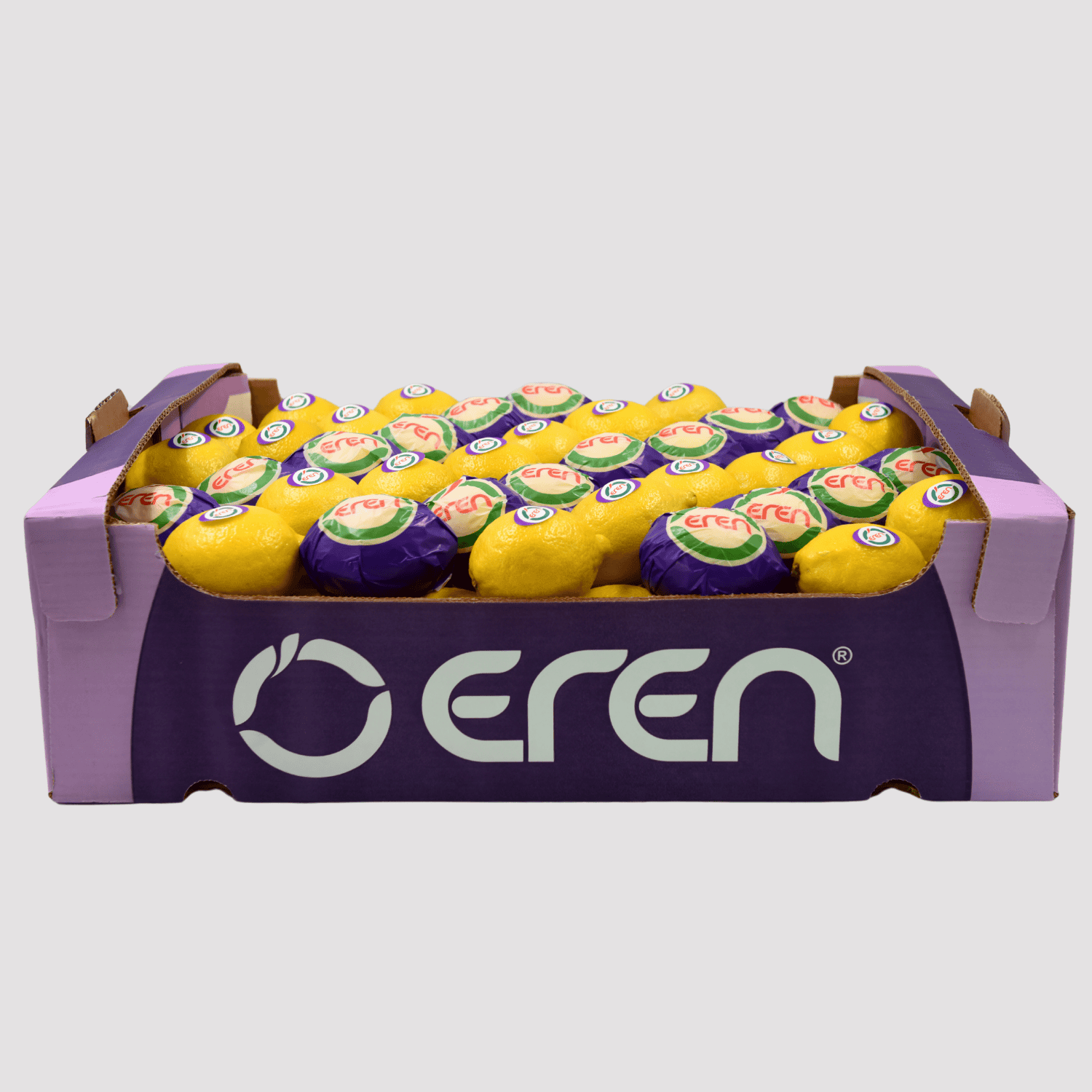
Lamas lemon is worth calling out here because it genuinely bends the rules. Most citrus varieties have a harvest window of a few months, tops. Lamas, on the other hand, stretches its active harvest and storage availability across the better part of eight or nine months of the year — starting in January and running clean through into August, with residual storage supply extending even further. That kind of range is unusual in the citrus world and it's one of the reasons Lamas ends up being a workhorse variety for exporters who need dependable, near-continuous lemon supply rather than a short sharp burst.
The Complete Citrus Fruit Season Calendar
Let's get concrete. Below is a rundown of the major citrus categories grown across Turkey's export regions, along with roughly where their peak, active harvest, and storage-supported windows fall across the year. Storage-supported simply means the fruit was picked earlier and is being held in controlled conditions to extend its availability — it's not a lesser product, it's just a different stage in the supply timeline.
| Citrus Type | Key Varieties | General Season Window | Notes |
|---|---|---|---|
| Lemon | Meyer, Interdonato, Lamas | Year-round, Lamas dominant Jan–Aug | Lamas offers the longest continuous window of any variety |
| Mandarin | Satsuma, Miho Wase, Nova, W. Murcott, Tangelo/Minneola, Mandora | Oct–Apr, staggered by variety | Satsuma opens the season early; Tangelo/Minneola runs into spring |
| Grapefruit | Star Ruby/Rio Red, Ruby Red, White Marsh | Oct–Jun | Star Ruby has one of the broadest windows of any grapefruit variety |
| Orange | Washington Navel, Navelina, Cara Cara, Valencia/Midnight, Trablus, Jaffa, Lane Late | Nov–Aug | Navel varieties lead into winter; Valencia and Lane Late extend into summer |
| Kumquat | Kumquat | Jan–Aug | A long, steady harvest window similar to Lamas lemon |
Notice how the windows overlap and stagger rather than lining up neatly by calendar quarter. That staggering is deliberate — it's the result of decades of variety selection aimed at extending the total window a grower or exporter can offer. Nobody wants forty warehouses full of the same fruit ripening in the same fourteen days.
Lemons: Meyer, Interdonato, Lamas
Meyer lemon tends to show up earlier in the calendar, offering a milder, slightly sweeter profile compared to more acidic lemon varieties. Interdonato follows a similar early-season pattern and is prized for a thinner rind and strong juice content. Then there's Lamas, already mentioned, which anchors the mid-to-late season and does the heavy lifting for continuous supply through spring and into summer.
Mandarins: Miho Wase to Mandora
The mandarin lineup is genuinely long. Satsuma tends to open early, offering that classic easy-peel, seedless profile. Miho Wase and Okitsu follow shortly after. Fremont and Nova bring a slightly different flavor profile into the mix during the core winter months, and W. Murcott extends things further. Tangelo/Minneola — a cross between mandarin and grapefruit lineage — brings a distinct tangy-sweet character and tends to run in two separate windows across the season, making it a useful bridge variety. Mandora rounds things out toward the tail end of the mandarin calendar.

Grapefruit: Star Ruby, Ruby Red, Marsh
Star Ruby (sometimes labeled Rio Red) is the flagship grapefruit variety out of Turkey's growing regions, known for its deep red flesh and relatively low bitterness compared to older grapefruit varieties. It also happens to have one of the longest availability windows of any citrus type grown here, stretching from early winter storage supply right through into the following summer's fresh harvest. Ruby Red and White Marsh fill in supporting roles with slightly shorter, more concentrated windows.
Oranges: Navelina to Lane Late
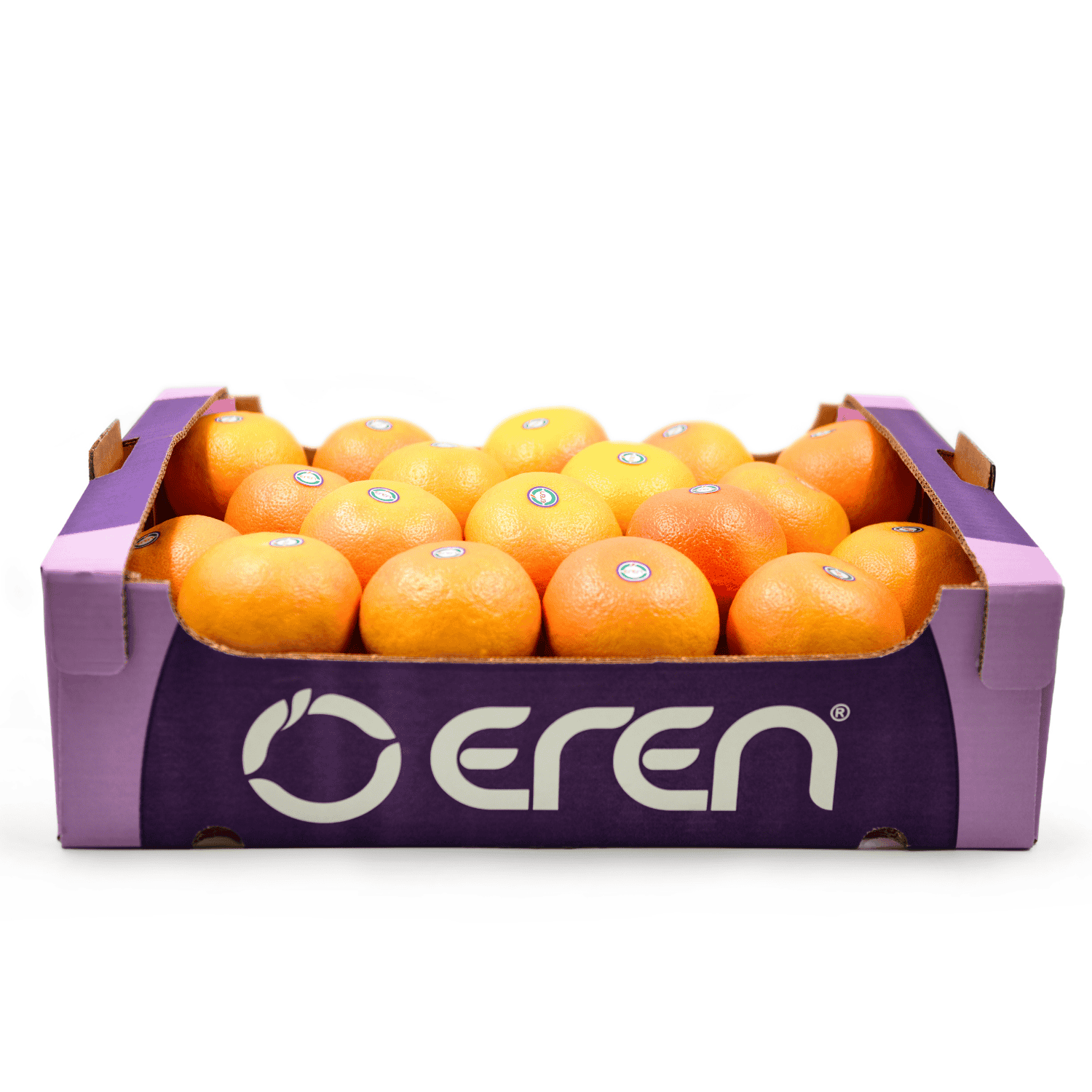
Oranges follow probably the most classic seasonal arc of any citrus category. Navelina and Washington Navel dominate the early-to-mid winter months, offering that seedless, easy-to-eat profile people expect from a good eating orange. Cara Cara, with its distinctive pink-red flesh, runs alongside the navel varieties. Then, as winter turns to spring, Valencia (also labeled Midnight in some markets) takes over and is specifically valued for how well it holds up into the warmer months — it's often the variety still shipping fresh well after most other oranges have finished their run. Trablus, Jaffa, and Lane Late each play supporting roles at different points, giving exporters flexibility to match specific market preferences.
Kumquat
Kumquat is a smaller niche category but a genuinely interesting one — a long, steady harvest window running roughly January through August, similar in shape to Lamas lemon. Because the whole fruit (peel included) is edible, kumquat tends to serve specialty and gourmet market segments rather than mainstream bulk citrus orders, but demand has been steadily growing.
Why Fall Citrus Kicks Off the Real Action
Fall citrus is where the whole season really gets moving. As temperatures start dropping in September and October, early mandarin varieties like Miho Wase and Dobashi Beni begin their harvest window, followed shortly by Satsuma. This is also when the first navel oranges and early lemon supply start entering active harvest.
Why does fall matter so much strategically? Because it's the transition period where buyers who source citrus internationally are shifting away from Southern Hemisphere supply and looking toward Northern Hemisphere origins like Turkey to fill the gap. Getting the timing right during this window can mean the difference between smooth supply continuity and an awkward stock gap. Turkish growers have gotten very good at hitting this window consistently, which is part of why fall citrus from Turkey has built such a strong reputation with buyers who plan supply chains a full year out.
There's also a quality argument for fall harvest specifically. The transition from hot summer days to cooler autumn nights tends to help citrus develop good color and sugar-acid balance, which is part of why early-season fruit — even though it's the first off the trees — often eats really well right out of the gate rather than needing extra ripening time.
Winter Citrus Fruits: Turkey's Peak Production Window
If fall is the opening act, winter is where the whole show happens. Winter citrus fruits represent the highest-volume, highest-diversity window of the entire calendar in Turkey. By December and January, you've got nearly every major citrus category running at some stage of active harvest simultaneously — Washington Navel and Navelina oranges, Cara Cara, a full spread of mandarin varieties, Star Ruby grapefruit hitting peak, and Lamas lemon in full swing.
This is also, not coincidentally, when domestic and export demand both spike. Winter is peak citrus-eating season across most of the Northern Hemisphere — cold weather, flu season, people reaching for vitamin C, all of that plays into demand patterns. Winter citrus from Turkey ends up meeting that demand at exactly the moment it's highest, which is a big part of why the country's export numbers (more on those shortly) show such heavy winter concentration.
Logistically, winter is also the most demanding season for exporters. Cold chain management has to be tight, packaging has to hold up over longer transit routes to colder-climate destination markets, and volume planning has to account for the fact that basically every variety is competing for cold storage and container space at the same time. It's the season that separates well-run export operations from ones that are just winging it.
There's a labor dimension to this too that doesn't get talked about enough. Winter's overlapping harvest windows mean packhouses need significantly more staff on hand than during quieter stretches of the year — sorting, grading, packing, and loading all need to happen at a pace that keeps up with the volume coming in from the fields. Well-established exporters plan for this seasonal staffing surge well in advance, often bringing on hundreds of additional workers during the peak months to keep quality consistent even as throughput multiplies. It's one of those behind-the-scenes operational realities that ultimately shows up in whether a shipment arrives properly sorted and well-packed, or not.
Citrus in Season Now: A Snapshot Across the Year
People ask this question constantly — what's citrus in season now, whatever "now" happens to be when they're asking? Because the honest answer changes every few weeks, here's a simplified snapshot:
- January–February: Lamas lemon, Star Ruby grapefruit, Washington Navel and Navelina oranges, Cara Cara, W. Murcott mandarin, kumquat
- March–April: Valencia orange transitioning in, Lane Late orange, later mandarin varieties, Lamas lemon still going strong
- May–June: Valencia orange peak, Lamas lemon storage supply, grapefruit storage supply
- July–August: Tail end of Lamas lemon and kumquat, limited fresh citrus, mostly storage-supported supply
- September–October: Early mandarins (Miho Wase, Dobashi Beni, Okitsu) begin, Meyer lemon starts
- November–December: Full mandarin lineup, Navelina and navel orange harvest ramps up, Tangelo/Minneola in peak window
The takeaway is that citrus season in Turkey isn't a three-month event — it's a continuously rotating supply chain where something is always either at peak, in active harvest, or being pulled from storage. If you're planning purchases a year in advance, this rolling structure is genuinely more useful to understand than any single "season" label.
Four Seasons Citrus: How Turkey Supplies Almost Year-Round
This is really the headline story of Turkish citrus production: it functions as close to four seasons citrus supply as you're going to find from a single origin country. Very few citrus-growing regions in the world manage to keep some variety in fresh or storage-supported supply across essentially all twelve months, but between Lamas lemon, kumquat, Star Ruby grapefruit, and the staggered mandarin and orange lineups, Turkey gets remarkably close.
The only real gap is a short stretch in mid-to-late summer where fresh harvest volume genuinely thins out and supply leans more heavily on storage-held fruit from the spring harvest. Even that gap has been narrowing over the years as growers refine variety selection and storage practices, but it's worth being upfront about it rather than pretending citrus grows fresh in Turkey every single week of the year.
For buyers, this near-continuous model is a big deal. It means fewer supplier switches, more consistent quality benchmarks to work from, and simpler forecasting — you're mostly managing which variety and which stage (fresh vs. storage) rather than juggling entirely different countries of origin depending on the month.
It also simplifies something buyers rarely talk about openly but that matters enormously in practice: relationship continuity. Switching origin countries mid-year means re-qualifying a new supplier, re-checking phytosanitary requirements, re-negotiating packaging specs, and generally starting the trust-building process over. Working with a single origin that can genuinely cover most of the calendar means that relationship-building work happens once and then compounds — the exporter learns your specific requirements, you learn their production rhythms, and the whole process gets smoother year over year rather than resetting every few months.
2025 Export Performance: Numbers Behind the Season
Numbers help put all of this in perspective. Turkey's citrus export sector had a genuinely record-breaking 2025, both in volume and — more strikingly — in value. Total exported volume for the year came in at roughly 1.5 million tons, generating export revenue of close to 1.48 billion dollars. That revenue figure represented a jump of about 41 percent compared to the year before, a growth rate that's hard to overstate for an established agricultural export category.
| Product | 2025 Export Volume / Value | Share of Total |
|---|---|---|
| Mandarin | ~944,000 tons / ~$912.5 million | ~62% |
| Lemon | ~$402.4 million | — |
| Orange | ~$96.2 million | — |
| Grapefruit | ~$65.1 million | — |
Mandarins clearly carried the sector in 2025, accounting for roughly 62 percent of total citrus export value — a dominant share that reflects both strong yields and strong international demand for Turkish mandarin varieties specifically. Lemon came in as a solid second category, followed by orange and grapefruit rounding out the mix.
First Half of 2026: Momentum Continues
2026 picked up right where 2025 left off. Across the first six months of the year (January through June), Turkish citrus exports reached roughly 807,000 tons in volume, generating export revenue of around 911 million dollars. Compare that to the same period the previous year, which came in at roughly 518.7 million dollars, and you're looking at growth of nearly 75 percent — a genuinely striking acceleration even against an already-strong 2025 baseline.
Breaking that first-half figure down by product, mandarin again led the pack at around 532.3 million dollars, followed by lemon at roughly 213.3 million dollars, orange at about 110.4 million dollars, and grapefruit contributing close to 54.6 million dollars. The proportional ranking stayed consistent with the full-year 2025 pattern — mandarin first, lemon second, orange third, grapefruit fourth — suggesting a stable underlying demand structure rather than a one-off spike in any single category.
Where Turkish Citrus Travels: Key Export Markets
Geography plays out clearly in the destination data too. Across full-year 2025, Iraq was the single largest destination market for Turkish citrus, with exports valued at roughly 544.2 million dollars, followed by Russia at about 461 million dollars. Ukraine, Poland, and Romania rounded out the top five, at roughly 106.4 million, 52 million, and 48.4 million dollars respectively.
That same ranking held largely steady into the first half of 2026: Iraq again led at around 357.2 million dollars, Russia followed at roughly 235.6 million dollars, with Ukraine, Poland, and Romania again occupying the third, fourth, and fifth spots at approximately 47.2 million, 41.2 million, and 36.2 million dollars.
The consistency of this market ranking across two consecutive periods tells its own story — these aren't opportunistic one-off orders, they're established, repeat-buyer relationships built over years of reliable supply. It also reflects logistics reality: Iraq and the broader regional market benefit from shorter transit routes and established trade corridors, while Russia and Eastern Europe have long-standing import relationships with Turkish citrus exporters going back decades.
It's worth digging into why these five markets in particular keep showing up at the top. Iraq's proximity means truck logistics are often viable alongside sea freight, which shortens lead times considerably and makes it easier to move fresh, short-window varieties without leaning as heavily on extended cold storage. Russia's relationship with Turkish citrus exporters goes back well before either of the periods covered here, built on decades of trade ties across the Black Sea region, and Russian buyers have historically valued the consistency and volume capacity that established Turkish exporters can offer, especially during peak winter demand months.
Ukraine, Poland, and Romania rounding out the top five points to something else worth noting — a broader Eastern and Central European demand base that has remained remarkably stable even amid regional disruptions over the past several years. That stability matters for exporters trying to plan production and logistics capacity a year ahead, since it means the demand side of the equation is at least somewhat predictable even when other parts of the picture are in flux. Beyond these top five, Turkish citrus exporters also maintain steady relationships across Northern Europe, parts of the Gulf, and increasingly Southeast Asia and Africa, reflecting the broader push toward market diversification that's been a hallmark of the sector's growth over the past decade.
Production Outlook for 2025/2026
On the growing side, the 2025 season benefited from genuinely favorable weather through the flowering period, which translated into strong overall yield across most citrus categories. Good flowering conditions early in the growth cycle tend to set the tone for the entire season, since flower quality and fruit-set rates are established months before harvest even begins.
Looking ahead to the 2026 fall harvest, the outlook is cautiously positive — assuming no major weather disruptions between now and then, the combination of favorable spring conditions and wider adoption of biological pest control methods across growing regions points toward another season of solid quality and potentially improved yield. Biological pest control in particular has been gaining ground as an alternative to heavier chemical input regimes, which tends to align well with the quality and residue standards that international buyers, particularly in the EU, increasingly expect.
None of this happens in isolation from the broader climate picture either. Growers across the citrus belt have been paying closer attention in recent years to irrigation efficiency and water management, since predictable water access during the flowering and fruit-development stages has a direct, measurable impact on both yield and fruit size distribution. The combination of better agronomic monitoring, more targeted irrigation scheduling, and wider biological pest control adoption is part of why the sector has been able to post consecutive years of strong performance rather than the boom-and-bust cycles that can affect less professionally managed growing regions.
Packaging and Quality Standards for Export
Growing good citrus is only half the job — getting it to a destination market in the same condition it left the packhouse is the other half, and honestly it's the half that trips up less experienced exporters. Turkish citrus destined for export typically goes through optical sizing and sorting before it ever reaches a carton, which sorts fruit by size, color uniformity, and surface defects far more consistently than manual sorting ever could. That consistency matters a lot once you're filling containers meant to travel thousands of kilometers.
Packaging specifications vary a fair amount by destination market. European buyers tend to have specific requirements around carton weight, ventilation design, and labeling that includes traceability information back to the grower and packhouse. Middle Eastern and regional markets sometimes prefer different carton formats altogether, reflecting local retail display norms. A good exporter treats this as a standard part of order fulfillment rather than something to negotiate after the fact — matching carton type, weight, and labeling to what a specific market actually expects.
Cold chain management is the other piece that can't be skipped. Citrus fruit, even hardy varieties like Star Ruby grapefruit or Lamas lemon, needs consistent temperature control from the moment it leaves the packhouse through however many days or weeks of transit to reach its destination. Reefer container logistics, proper pre-cooling before loading, and temperature monitoring throughout the voyage are all standard practice among established exporters, and honestly they're the difference between fruit that arrives in great shape and fruit that arrives disappointing everyone involved.
Quality control departments at established exporters typically run multiple checkpoints — at intake from growers, after sorting, before palletizing, and often again just before loading — checking for internal quality (juice content, brix levels, acidity) as well as external presentation. This layered approach to quality control is part of why buyers who've worked with established Turkish exporters for years tend to stick around; the consistency compounds over time into genuine trust.
Frequently Asked Questions
When does Turkish citrus season actually start?
It depends on the variety, but the earliest activity typically begins in September with early mandarin varieties like Miho Wase, followed by Meyer lemon shortly after. The core of the season, covering the widest range of varieties simultaneously, runs through the winter months.
Is there a variety available almost all year?
Yes — Lamas lemon and kumquat both offer unusually long harvest and storage-supported windows, running from January through roughly August, which makes them the closest thing to a true year-round citrus supply in the Turkish lineup.
Which citrus category is Turkey's biggest export?
Mandarin, by a clear margin. It accounted for roughly 62 percent of total citrus export value in 2025 and has maintained that leading position into 2026.
Which countries buy the most Turkish citrus?
Iraq and Russia consistently rank as the top two destination markets, followed by Ukraine, Poland, and Romania rounding out the top five in both full-year 2025 and the first half of 2026.
Does storage-supported fruit mean lower quality?
Not at all — it simply means the fruit was harvested earlier in its window and held under controlled conditions to extend availability. It's a standard and well-managed part of extending a variety's usable season rather than an indicator of reduced quality.
How far in advance should buyers plan citrus orders?
Given how staggered the variety windows are, most experienced buyers plan a full year ahead, mapping out which varieties they'll need month by month rather than placing reactive orders once stock runs low. This is especially true heading into the winter peak window, when demand across every citrus category rises at once and container space gets tighter.
What's the difference between fresh and storage-supported Star Ruby grapefruit?
Fresh Star Ruby is picked and shipped within a short window of harvest, while storage-supported supply has been held under controlled cold conditions after an earlier harvest to extend the variety's total availability window. Because Star Ruby has one of the broadest windows of any grapefruit variety grown in Turkey, both fresh and storage-supported supply are available for a large part of the year.
Get Fresh Turkish Citrus From FreshAnatolia
All of this — the varieties, the calendar, the export numbers — comes together at FreshAnatolia, part of the Eren group, which has been in the fresh produce export business since 1993. What started as a small citrus-focused export operation out of Mersin, mainly serving Russia and Southern Europe, has grown into an operation exporting more than 60 product varieties to 63 countries around the world, backed by its own production facility in the Tarsus region, its own quality control department, optical sizing and sorting technology, and an in-house logistics division covering trucking, container, reefer, and air cargo shipping under a range of Incoterms.
With sales staff fluent in seven languages and deep experience navigating the customs procedures, packaging preferences, and cultural expectations of dozens of different markets, FreshAnatolia is built to handle sourcing needs across the full citrus fruit season calendar — from the earliest fall mandarins right through to the last of the Lamas lemon supply the following summer.
If you're planning citrus sourcing for the year ahead, or just want a clearer picture of what seasonal citrus availability actually looks like month by month, reach out to the FreshAnatolia team. Whether it's Lamas lemon, Star Ruby grapefruit, Satsuma mandarin, or any of the other varieties covered in this guide, the team can walk you through exact timing, volumes, and logistics options built around your specific market. Turkey's citrus season is long, layered, and genuinely one of the more reliable supply calendars in the produce world — and Eren has spent over three decades learning how to work it properly.
Beyond citrus, FreshAnatolia's broader catalog spans stone fruits, soft fruits, and a full range of fresh vegetables grown across Turkey's diverse growing regions, all backed by the same quality control processes, optical sorting infrastructure, and logistics capability described throughout this guide. Whether your business needs a single citrus variety to fill a specific month-long gap or a full-year sourcing plan spanning multiple product categories, the team is set up to build a supply schedule around what your market actually needs, rather than asking you to fit your planning around someone else's default calendar. Get in touch, share your target markets and volumes, and let's map out a citrus supply plan that actually holds up across the full year.